

Google’s Freshness Update was a significant ranking algorithm change that introduced the trend of making the search results more precise and responsive to user intent.
The result of the update was the ability to add time as a relevance measure for search queries. This enabled Google to surface content that is trending, regularly occurring (like a yearly event), or subject to frequent updating (like new product models).
The Freshness Update was made possible by the infrastructure changes introduced by the Caffeine Update, which enabled Google to scale up web indexing at an unprecedented scale, enabling Google to surface the most up-to-date content that is literally up-to-the-minute relevant.
The algorithm update was announced on November 3, 2011.
Google’s official blog post announcement stated that the change impacted about 35% of search queries and noticeably affected approximately six to 10% of search queries.
That is a significant change in how webpages are ranked.
Why Is It Called Freshness Algorithm?
The “freshness” name for this update is directly taken from the official Google announcement:
“Google Search uses a freshness algorithm, designed to give you the most up-to-date results.”
What Made This Algorithm Update Possible
A reason why Google released the Freshness Update was that the new Caffeine indexing system provided Google the ability to process more webpages faster.
The Caffeine infrastructure made it possible for Google to provide fresh results with a higher degree of relevance by using a more granular definition of what freshness means.
Specifically, Google determined that some queries have three different kinds of time-related relevance factors.
The three kinds of time-related queries are:
- Recent events: These are search queries that relate to trending or current events, generally news related.
- Regularly recurring events: Google’s announcement gave the example of annual events, elections, sports scores, TV shows, and corporate earnings reports.
- Frequent updates: These are time-related queries for topics that frequently update but aren’t events or trending topics. Examples are search queries for products that are frequently updated.
Freshness For Trending Topics And Recent Events
Trending Topics
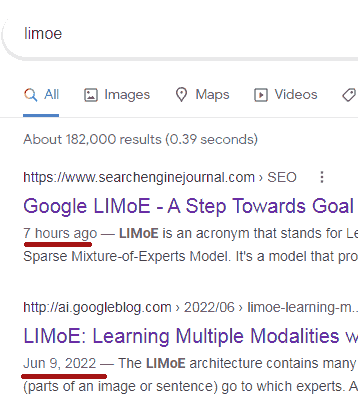
Google shows fresh results for certain queries, particularly if they are trending.
Here’s an example with the keyword LIMoE, which is the name of a Google algorithm:
Recent Events
When the algorithm was released there was no such thing as the Top Stories news section for current events.
Google simply showed news results related to recent events at the top of the search results.
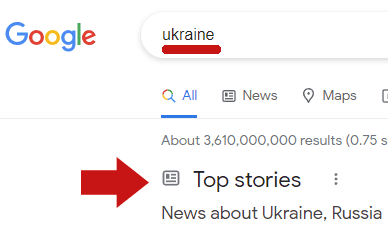
Today, Google will show a Top Stories section when a search query has a recent event type of relevance component.
For example, a search query for Ukraine surfaces the following search result:
Freshness For Regularly Recurring Events
This kind of freshness relates to events that happen on a regular basis but aren’t necessarily trending.
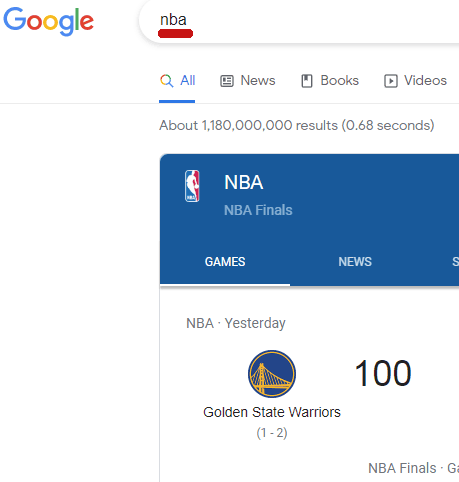
Google used the example of a search query that is related to sports as a recurring event type of search query.
A search for NBA surfaces recent sports scores:
A presidential election recurring event will have to be updated every four years.
Frequent Update Freshness
The third type of freshness is related to search queries about topics that are always updated, like queries related to product reviews.
For example, the Samsung Galaxy phone has been around for many years and has cycled through multiple models.
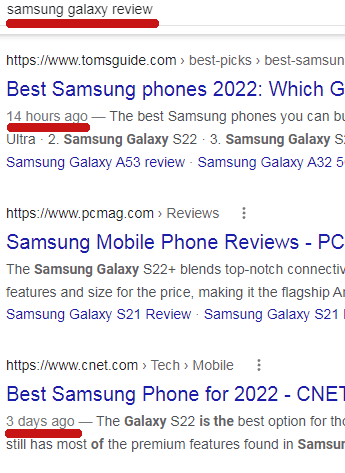
Ideally, when searching for Samsung Galaxy Review, the best result will be reviews about the latest models.
This is a search result for that search query:
Query Deserves Freshness (QDF)
Google’s Freshness Algorithm update was not the first time Google used time-related relevancy ranking factors.
In 2007, Amit Singhal (then a Google engineer and a senior vice president), introduced the Query Deserves Freshness (QDF) algorithm in an interview with the New York Times.
In a New York Times interview he explained what QDF was:
“Mr. Singhal introduced the freshness problem, explaining that simply changing formulas to display more new pages results in lower-quality searches much of the time.
He then unveiled his team’s solution: a mathematical model that tries to determine when users want new information and when they don’t.
(And yes, like all Google initiatives, it had a name: QDF, for ‘query deserves freshness.’)
…THE QDF solution revolves around determining whether a topic is ‘hot.’
If news sites or blog posts are actively writing about a topic, the model figures that it is one for which users are more likely to want current information. “
The difference between QDF and the Freshness Algorithm Update is that the QDF algorithm appears to have been more limited in scope and less nuanced than the Freshness Algorithm.
In a Nutshell: The Difference Between QDF And Freshness Algorithm
- QDF was examining if a topic was trending among news sites and blogs.
- The Freshness Algorithm examined search queries to determine if they belonged to one of three categories of queries that required fresh results.
As mentioned earlier, the Caffeine web indexing system, introduced five months before the Freshness Algorithm, provided Google the ability to provide search results that were relevant to the minute.
The fact to remember about QDF is that the 2007 Query Deserves Freshness algorithm preceded the 2010 Freshness Algorithm.
What can cause confusion is that Googlers continued to make references to the concept that a Query Deserves Freshness well past 2010. So even in 2012, Matt Cutts was referencing the concept in a Google Webmaster Video that certain queries deserve freshness.
Nevertheless, they are two different algorithms that were introduced three years apart and apparently did different things, since the technology that made the Freshness Algorithm possible in 2010 (the Caffeine web indexing system) didn’t exist in 2007.
Is Fresh Content Necessary To Rank?
Not all search queries require fresh results. Many search queries are evergreen.
Evergreen, in relation to the information needs of search queries, means that the answer to some queries doesn’t change much, if at all.
An example of evergreen content is a recipe. The method for how to make chocolate cookies stays relatively the same for many years.
Sometimes, there are cultural changes that affect evergreen content, such as a trend to low fat or low sugar cookies, which might change how cookies are made.
But the cookie recipe is still evergreen.
The Freshness Algorithm only kicks in when the search query fits into one of the following three categories:
- Recent events.
- Regularly recurring events.
- Frequent updates.
Myth Surrounding Fresh Content
There is an SEO strategy that recommends changing the date of publication or the modification date every week, month, or year because, according to the strategy, “Google loves fresh content.”
There are even WordPress plugins that will bulk update the post-update dates.
But the truth has always been that the “Google loves fresh content” idea is a myth.
Even three years after the launch of the Freshness Algorithm, Matt Cutts, a Google engineer, was still explaining that freshness is not always a ranking signal.
Matt explains this in a 2013 video where he answers how important freshness is for ranking.
“How important is freshness?
So there’s a little bit of an interesting twist in this question where it’s not just the case that something is frequently updated …in terms of the pages on your blog or on your site, that you automatically should be ranking higher.
So I wouldn’t have that interpretation of freshness. …not every query deserves freshness.
So if it’s a navigational thing, if it’s evergreen content, sometimes people are looking for long-form content or doing more research, then freshness wouldn’t be counting as that much.
…we have over 200 signals that we use and the thing that I would not do, the pitfall, the trap that I would not fall into is saying, okay, I have to have fresh content, therefore I’m going to randomly change a few words on my pages every day and I’ll change the byline date so that it look like I have fresh content.
That’s not the sort of thing that’s more likely to actually lead to higher rankings.
And if you’re not in an area about news, if you’re not in a sort of niche or topic area that really deserves a lot of fresh stuff, then that’s probably not something that you need to worry about at all.
…there’s some content that’s evergreen that lasts and stands the test of time. It might be better to work on those sort of articles…
…if you write about video games, there’s a lot of like topical breaking news, then it is good to try to be fresh and make sure that you have, you know, content that’s especially relevant.”
Who Needs To Rank For Freshness Algorithm
Publishing new content regularly is generally a good strategy for many kinds of websites.
However, publishing up-to-date content for websites on certain topics is especially important.
Websites on topics related to rapidly changing consumer trends, topics surrounding regularly occurring events, and sites about products that are frequently updated require a steady stream of fresh content.
The upside of publishing news and trending content is that it can result in high levels of traffic, sometimes immense amounts of traffic.
The downside is that after a couple of weeks it may no longer be fresh or relevant to the same search queries that triggered the massive traffic when the topic was trending.
The best thing to do is to understand if your content topics fit into one of the three freshness categories and if so, get writing.
If the content topic doesn’t fit into those categories, then the topic is evergreen.
And it’s not a bad idea to have a mix of both fresh and evergreen topics so that visitors arriving for the freshness have the opportunity to stay for the evergreen.
Knowing what the Freshness Update was about is still useful for developing a content strategy because Google today is better able to understand which queries deserve freshness, which creates opportunities for publishers to gain more traffic.
More Resources:
- Fresh Content As A Google Ranking Factor: What You Need to Know
- Will Swapping Fresh Content Help Your SEO?
- Google Ranking Factors: Fact Or Fiction
Featured Image: A.Azarnikova/Shutterstock
