

While browsing the internet or optimizing websites, you may have come across sites that are not using “www” prefixes, instead opting for non-www.
For example, URLs with www:
- https://www.example.com
- http://www.example.com
And URLs without www:
- https://example.com
- http://example.com
Does it matter if a site is using www or non-www URLs, and is there an SEO impact to using one versus the other?
Let’s explore. Before we get into the details, let’s better define what www and non-www are.
What are www and Non-www?
The terms “www” and non-www” are often used to simply describe whether a URL includes “www.”
The World Wide Web (WWW) describes the vast collection of textual documents and multimedia files that can be accessed using the Internet.
The URL or web address is translated by the name server into an IP address, which your browser connects to in order to serve the webpage.
When the Internet began, all websites started their domains with www. But several years ago, more and more sites started to use non-www domains because user behavior has changed.
A non-www domain is often referred to as a “naked” URL.
Is www or Non-www Better for SEO?
It does not really matter which one you use from an SEO perspective, but there are a few pros and cons for each.
If you have the non-www version as the preferred version of your site, you should not have the www domain indexed.
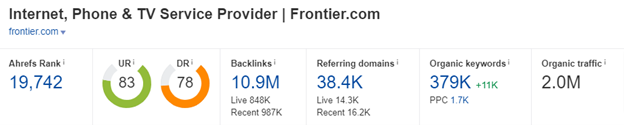
For example, let’s look at Frontier Communications. This domain is accessible at https://frontier.com, which is fine.
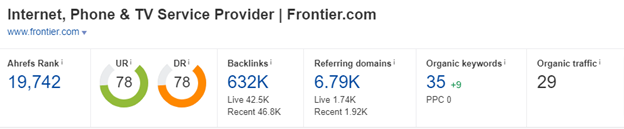
Once you type in www.frontier.com it automatically 301 redirects to the preferred version, i.e., https://frontier.com.
If Frontier had both versions indexed, it would potentially cause a duplicate content issue and link equity could be spread across both versions.
That’s a big no-no, but luckily this is not the case.
You’ll notice the www version has far fewer backlinks, referring domains, and organic traffic. That’s because it is being redirected to the non-www domain.
Frontier stuck with one version, which is the correct thing to do.
If you want to use both, please ensure you set up 301 redirects to the preferred version – and not 302 redirects.
That’s because 302 redirects do not transfer PageRank over to the redirected domain/page as well as 301s.
The extreme sports site extreme.com set up a 302 redirect to the www version from the non-www version. As a result, they probably lost some traffic and link authority.
Instead, extreme.com should have used 301 redirects.
When you set up redirects the experience is seamless for users. Regardless of what they type to reach your site, Google and other search engines will recognize the preferred domain and also spread the link authority accordingly.

Which One Should I Use?
The answer is either one.
It’s possible eventually www domains will become obsolete as most people don’t bother typing them in while searching for a website.
These days, it is becoming more common not only on desktops but also in mobile browsers such as Google Chrome for “www” to be hidden by default, which leaves some wondering if it could be obsolete in the future.
Once you decide which one to use, make sure all your sitemap URLs and internal links use your preferred version and, if you can control them, your backlinks should be consistent as well.
Can I Use Both Non-www and www?
Technically, you can use both non-www and www in your domain, but it is not recommended.
In fact, Google will see this as two separate sites.
If you have both versions indexed, you would have to set up and maintain both sites in Google Search Console, you’d face duplicate content issues, and your link equity would be split between the two domains.
This can potentially harm your search engine rankings, so you need to choose one and stick with it.
My personal preference is to use www because the majority of sites use it and when sites are linking to you, they tend to link to the www version or just type in the domain name.
If you need to have both sites indexed for a technical reason like your CMS does not have the ability to set up 301 redirects, then you can use canonical tags.
A canonical tag is an HTML tag that helps websites prevent duplicate content by specifying the “canonical” or “preferred” version of a webpage or domain to Google.
This way you signal to Google, “I know I have a duplicate version with the non-www site and so I have the canonical tags pointing to the www version on the non-www site.”
It’s important to note Google treats canonicals as recommendations and not instructions. As a result, both website versions could still be indexed.
Pros & Cons of www and Non-www
While either non-www or www can be used, there are some pros and cons to using one over the other, which are outlined below.
This can help you decide which one to use:
| Pros | Cons | |
| www | Used for years and considered a standard. | Takes longer to type, most people don’t say www when announcing it in broadcasts. Modern users might skip it. |
| www | Allows you to set cookies for your specific www subdomain.
It’s also easier to set up a CDN.
|
Takes up more space in the address bar. (And now Google hides it unless you click on the URL.) |
| non-www | It’s a short domain. | There’s no option to restrict cookies only to the root domain. |
| non-www | It’s easier to say and pronounce. | It will be harder to get a CDN to work, as you will not be able to set a CNAME record for your root/naked domain without messing up other things like FTP and Mail.
|
Wrapping Up
Use whatever version is right for your business, goals, and objectives. Keep in mind that the www version is better suited for technical purposes as mentioned in the table above, and your needs may change in the future as the site and business grow.
If you are starting a new site, you have to stick with one or the other.
If you have a site that is established, stick with whatever you have and don’t change it.
Redirects should only be used if absolutely necessary. Once they are used, it will take Google some time to crawl and index the changes and some visibility can be lost.
If you have both versions indexed, make sure your 301 redirects to the preferred version that has the most traffic, links, and authority. Continue to optimize and build content to make your brand a success online.
More Resources:
- The Ultimate Guide for an SEO-Friendly URL Structure
- A Technical SEO Guide to Redirects
- Advanced Technical SEO: A Complete Guide
Featured image: M.IWA/Shutterstock
