

A discussion in a private Facebook group centered on whether no follow links had any SEO value. One member claimed he ranks web pages exclusively with no-follow links. I considered the popular arguments why no follow links are important and discovered some interesting information about them.
There were four reasons why SEOs felt that no follow links have ranking value:
- Google sees them, as evidenced by Google Search Console
- No-follow links add diversity to a backlink profile
- Sites with exclusively do-follow links appear unnatural
- No-follow links make backlink profiles appear natural
Google Search Console Shows No Follow Links
The fact that Google shows links in the GSC is not evidence that Google assigns any kind of ranking power. Some SEOs claim that this is evidence that Google “sees” the links.
This “seeing” is confused with Google using it for ranking purposes. This is a mistake.
Knowing a link is there and counting the link for ranking purposes are two different things. Consider that Google “sees” do-follow links and only passes partial PageRank. The “seeing” part is 100% meaningless.
What counts is how the link is used for ranking purposes. Google has been clear that no-follow links do not count for ranking purposes.
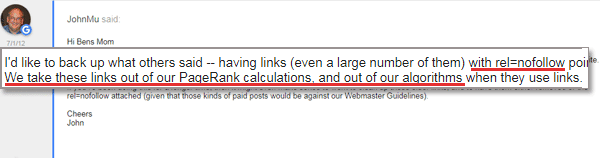
Here is what John Mueller stated about it:
“…having links (even a large number of them) with rel=nofollow pointing to your site does not negatively affect your site. We take these links out of our PageRank calculations, and out of our algorithms when they use links.”
Why Does Google Report No-Follow Links in GSC?
No follow links are displayed in Google Search Console (GSC) because it’s a link. Just because a link has a no follow dangling off of it doesn’t stop it from being a link. It’s still a link.
The tool is not showing you the links that help ranking. It just shows links, whether they help a site rank or don’t help a site rank.
Do No Follow Links Help Backlink Diversity?
Links help a site rank or they don’t help a site rank. That’s pretty much the definition of link diversity.
If you read any of the patents or research papers, you will never see “link diversity” cited as a ranking factor. Never.
You can read everything Matt Cutts has written or said and there’s nothing he has said that encourages publishers to acquire diverse links. There are pages that link to a Matt Cutts video to support the idea of link diversity but Matt doesn’t actually say the phrase link diversity or any variation of it.
Link diversity is not officially recommended by Google. You will not find link diversity recommended in any Google support page.
The concept of link diversity was invented by SEOs. It’s a way to hedge that if Google doesn’t give an SEO ranking credit for one kind of link then Google might give them credit for another kind of link.
So the whole argument that obtaining no-follow links because it gives you “diverse links” is false.
Diverse links is not a requirement for ranking well. The only diversity in links is between links that help a site rank and links that don’t help a site rank.
100% Do-follow Backlinks Look Unnatural
There are no research papers or patents that use no follow links as a way to judge the “naturalness” of a backlink profile. The latest research and patents on link analysis are concerned with actual links. No follow links are not mentioned.
There is nothing in the latest research and patents about no follow links because no follow links are by definition removed from consideration.
Do No Follow Links Help Ranking?
No-follow links have zero ranking power. Absolutely zero.
The definition of nofollow is to drop it from the link graph. Which literally means it no longer exists for ranking purposes. The influence of no-follow links for ranking cannot be any more zero than zero. It’s simply zero.
Can No Follow Links Help Ranking?
The short answer is yes, a no-follow link can have an indirect effect on rankings.
A no-follow link may cause someone to discover a useful page and link to it. A no-follow link from a popular related web page can help build popularity.
Google’s algo is tuned to satisfy the most users for the most popular user intent. Users expect to see certain sites or certain kinds of sites ranking for their search intent.
When you Google something like “worst president of the united states” you’ll find Obama ranking there. Phrases like “worst president” are associated by most people who search with that phrase with Obama. Those people expect Obama to rank for that phrase and Google’s algorithm is tuned to satisfy those searchers.
When you search for “stupidest president of the united states” you’ll find pages about Trump because searchers who use that phrase expect to see Trump.
Anything that increases your popularity will eventually influence the search engine. Google’s algorithm is tuned to show what users are expecting to see. This is the true secret of no follow links. Anything that helps increase your website’s popularity will help. Thus, a no follow link can be desirable if it increases your popularity and popularity is relevance to a search engine that wants to satisfy the most users.
