

Keyword research is the foundation of search engine optimization, and without it, you cannot expect to create sustainable and repeatable visibility.
Today, SEO is a much wider discipline than in the early days of the industry and has been segmented into many verticals.
But, at the core, SEO is about finding opportunities online and capturing relevant traffic to a website through visibility in search engines. Keyword research is at the heart of that SEO strategy.
This guide explains what keyword research is, why it’s important, and how you can make a start for a successful SEO strategy.
What Is Keyword Research?
Keyword research is a process of finding words, queries, and phrases that users are searching for, which means a keyword that has search volume.
Research involves connecting the relevance of keywords to a website and its individual pages so that the user can find the best page to answer their query, known as search intent.
Keyword research also involves categorizing search queries into the different stages of a user journey and different categories of search, such as transactional, navigational, and informational.
Good keyword research enables users to find what they need:
- Shoppers who want to buy something can find the right product page.
- A user that wants to know ‘how to’ can find a page that explains a process in-depth.
- Users who want to research a person or brand can find out about that entity.
Keyword research should also carefully consider if ranking on a keyword is worth the effort it would take to rank highly and get visitors. Not all traffic is equal.
Why Keyword Research Is Important For SEO
A search engine is an information retrieval system built around the queries that a user inputs to find an answer or relevant information to their search query.
The predominant focus of Google is to connect a user with the best answer to their query and the best website page so that a user is satisfied. Understanding this underlines SEO.
Good keyword research is the foundation of how a business can connect with its potential customers and audience. Understanding this helps to understand a good SEO strategy.
A business strategy starts with understanding its audience and their needs.
- What do they want?
- What do they need?
- What keeps them awake at night?
- What could solve their problem?
Keyword research is an extension of understanding your audience by first considering their needs and then the phrases, keywords, or queries they use to find solutions.
Keyword research is also important for SEO because it can show you where the opportunities are by knowing what your audience is searching for.
This will help you to find new areas of business and to prioritize where to focus attention and resources.
Keyword research will also help you to calculate where you can expect a return on investment to justify your efforts:
- Can a keyword deliver relevant traffic that has the possibility to convert to an end goal?
- What is an estimation of that traffic, and how much is each visitor worth to your business?
Basically, keyword research is the ultimate business research tool.
Read more: Why Keywords Are Still So Very Important For SEO
Keyword Research Basics
Monthly Search Volume
Monthly Search Volume (MSV) is a predominant measure of keyword value. It’s a useful metric as a starting point to consider if anyone is searching for that keyword, but it shouldn’t be used in isolation or as the only measure of value.
Just because a keyword has a high MSV doesn’t mean it is the right keyword for you to rank on.
High-volume keywords generally deliver ‘browsing’ traffic at the top of the funnel. They are useful for brand awareness but not for direct conversion.
Low-volume keywords can be much more valuable because they can deliver users who are ready to buy a product.
Read more: A Complete Guide To Keyword Search Volume For SEO
User Intent
User intent refers to what type of result they want to see when they search for a query – the intention of their search.
You will hear user intent talked about a lot in keyword research, as it is one of the most important factors in the process.
User intent is important in two ways, firstly because your primary aim in creating content and pages on a website are to provide a user with information that they want to know.
There’s no point in creating a page about what you care about – your user only cares about their problems and needs.
You can have the best page in the world about the history of cupcakes, but if a user searching for [cupcake] wants a recipe for cupcakes, then they will not click on your link.
Secondly, Google considers relevance when serving results pages (as we said above, they want to deliver the best result for a query). So, the better your page fits user intent, the better it might rank.
Read more: How People Search: Understanding User Intent
Relevancy
When Google considers which pages it will show in search results, the algorithm will look at other pages that users are clicking on for that query.
If we have a query such as [cupcake], Google has to consider if a user wants to know what a cupcake is, how to make a cupcake, or wants to buy a cupcake.
By looking at a search result page, you can get a good idea of user intent from the other results.
Reviewing the search results page of a query should be part of your research process for every keyword you want to consider.
Keyword relevance and user intent are much the same things. It’s about knowing what the user really means when they search. This is more ambiguous for head keywords and less so for long-tail queries.
Long-Tail keywords
Long-tail keywords are called long-tail because they fall to the right of the search demand curve – where the graph looks like a long tail stretching to the right.
The search demand curve is a graph that shows keywords with high volume to the left and lower search volumes to the right.
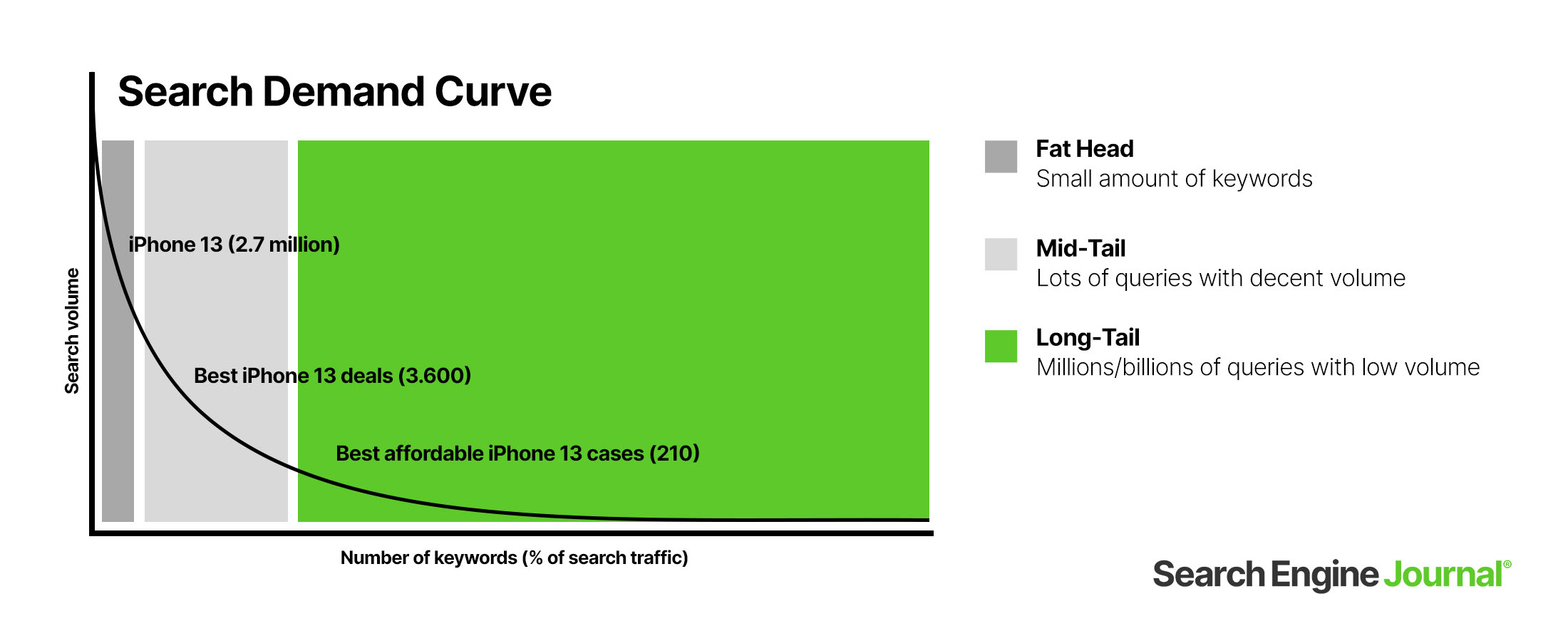
Longer queries that are more focused fall to the right. Head terms with broad meaning and high volume fall to the left.
The value of long-tail keywords is that they are usually highly focused terms that convert well, as users are actively looking for something very specific.
For example, [iPhone 13] is a head term with high volume (2.7 million MSV), and [Best affordable iPhone 13 cases] (210 MSV) is a long-tail keyword with far fewer searches but would have a high conversion rate.
Long-tail keywords are useful to include in a keyword strategy because they are usually much easier to rank for and achievable for a new website, and the cumulative volume of many long-tail keywords adds up to considerable targeted traffic.
This is a much more stable strategy than focusing on one high-volume ambiguous keyword.
Read more: Long-Tail Keyword Strategy: Why & How To Target Intent For SEO
Types Of Search Query

There are four types of keywords that are useful to understand as they categorize the different user intents and can help when planning a keyword strategy.
- Informational – users looking for information or an answer to a question (top of the funnel).
- Navigational – users wanting to find a specific brand, site, or page (brand searches).
- Commercial – users researching brands, products, or services (middle of the funnel).
- Transactional – users ready to complete a purchase or action (bottom of the funnel).
Local keywords can also be considered another category.
How To Do Keyword Research
Now that you have a better understanding of the basics of keyword research, we can look at where you would start with your research and keyword strategy.
1. How To Find Keyword Ideas
The first stage of keyword research is to brainstorm ideas for seed keywords, and there are several ways to do this.

Your Target Audience
Everything starts with your audience and what they want. Think about their needs, wants, and especially their pain points and problems.
Start to compile your wide list of words, ideas, and topics that surround your niche or business.
Think About Questions
Question-based keyword queries are valuable as they can help you to capture featured snippets and can be a way to jump rank on highly competitive keywords.
Ask your sales team and review CRM data to find the questions that your audience is asking.
Also, think of question modifiers that will start to build out your list:
- What [is a road bike].
- How to [ride a road bike].
- When is [the best time to service a road bike].
- What is [the best road bike].
- Where is [road bike shop].
Current Site Queries
If your site already has some online history, then Google Search Console can tell you what Google thinks your website is relevant for. This is insightful to tell you if your site is conveying the right message and to find opportunities.
If Google is showing a lot of queries that have nothing to do with your product or brand, then you need to apply more keyword focus to your pages.
Look for queries that are position 10 or greater, have reasonable impressions, and you think are relevant to your business.
These are potential quick-win opportunities that you can capture by making improvements and optimizing pages for the query.
Read more: A Complete Google Search Console Guide For SEO Pros
Competitors’ Keywords
Your competitors are a gold mine of information because they might already have invested in extensive research.
A business should be constantly monitoring its competitors anyway, so keep an eye on what content they are producing and the terms they target.
A keyword gap analysis will help you find opportunities your competitors are targeting that you might not have considered.
Seed Keywords
Start with high-level ‘seed’ keywords that you can use as a starting point to then open up variants and related queries.
Seed keywords are ‘big’ head terms such as [iPhone], [trainers], [road bike], or [cupcake].
For each seed keyword, start to think of topics that are related:
- Road bike maintenance.
- Road bike training.
- Road bike clothing.
- Road bike lights.
Also, use question modifiers and buying modifiers such as:
- Best [road bike].
- Buy [road bike].
- Price [for women’s road bike].
- [road bikes for hire] near me.
- Reviews [of road bikes under $1,000].
When you have finished this process, you should have a raw list of potential keywords grouped in topics – such as maintenance, clothing, training, etc.
2. How To Analyze Keywords
Once you have your raw list, it’s time to start to analyze and sort by value and opportunity.
Search Volume
Search volume will tell you if anyone is actively searching for this term.
For a first-stage strategy, you should aim for keywords with a mid-range and long-tail volume for quick wins and then build up to approach more competitive terms with higher volumes.
Head keywords with super high volumes (like ‘iPhone’) are not the best keywords to focus on as they can be too ambiguous and rarely have a specific intent.
Also, the amount of work that is needed to rank can be too high a barrier for entry unless you have an established domain of significant authority.
If a tool shows a keyword with zero search volume, this doesn’t always mean you should discard the term.
If the keyword is shown in the tool, then there can be value to consider targeting it in your strategy. However, make sure you know your audience and what is relevant to them before you invest resources in a zero-volume keyword.
Read more: Why You Should Target Zero Search Volume Keywords
Search Intent
After you have sorted your raw lists by search volumes, it’s then time to review the intent for each keyword that you would like to target.
The SERP will tell you everything that you need to know, and you should always review SERPs for clues on how to construct content and rank.
Look at the other listing that rank highly:
- Are they ‘how-to’ guides that indicate it’s informational?
- Do the titles say ‘buy,’ ‘best,’ or include product names?
- Is there a shopping carousel that indicates a buying keyword?
- Is there a location map that indicates it’s a local search?
Tag each keyword type and then consider which are the strongest keywords from each group.
You can also use a research tool that will tell you the type of keyword.
Topic Clusters

Grouping keywords into topic clusters is an advanced keyword strategy that can help to strengthen the topic authority of a site.
To do this, you would start with a high-volume head keyword and then research a series of keywords that supports that head term.
After creating pages of content that target each keyword, you use internal linking to connect pages with the same topic.
Read more: Keyword Clusters: How To Level Up Your SEO Content Strategy
3. How To Choose Organic Keywords
After sorting the volumes, intent, and topics, you will need to decide if you have a chance of ranking on a term by looking at how much competition there is for each keyword.
Keyword Difficulty
Keyword difficulty is one of the most important keyword metrics when doing your research.
If a keyword is so competitive that you need hundreds of thousands of dollars to rank, then you need to get strategic.
The easiest way to calculate keyword difficulty is to use a research tool that gives a score for each keyword.
Or, you can refer to Google Keyword Planner Tool and look at the CPC and level of difficulty. The higher the CPC bid, the higher the competition.
If you are starting out, first approach the lower competition keywords that are achievable and then build your way up to more competitive terms.
Read more: Why Keyword Research Is Useful For SEO & How To Rank
Connecting To Your Objectives And Goals
Unless a keyword can actually deliver a result for you – do you want to target it?
As we said above, targeting head terms is not the best strategy as they will, at best, deliver browsing or drive-by visitors. Unless you are a big brand with a big budget that is aiming for brand awareness, this is not the best application of your resources and budget.
Choosing your keyword priority should start with what can give you the best return in the shortest time frame.
Good keyword research is not just about trying to target a high-volume popular keyword. A good keyword strategy is about finding the right keywords for your needs and outcome. Always keep that front and center.
Read more: How To Calculate ROI For SEO When Targeting A Set Of Keywords
Watch John Mueller talk about ranking for head keywords in this video from the 38:55 minute mark.
Using Keyword Research Tools
Doing your research without a tool is limited; for the most in-depth keyword research, you need help to find keyword opportunities you had not thought of.
The following keyword research tools are all free versions that you can start out with.
Google Keyword Planner
The original keyword tool has evolved over the years, but it still remains one of the best free keyword tools and a good starting point to find seed keywords and keyword ideas.
The Google tool is aligned with Google Ads, so the data is skewed towards paid ads but is still valuable for research.
You need a Google Ads account to access the tool. Google will try to force you to set up an active campaign, but you can access the account by setting up an account without a campaign.
Without a campaign running, you will only get limited search volumes displayed in ranges, but the tool is still useful for its suggestions of keyword ideas. If you have an active campaign, Google will show you the monthly search volume.
You can add up to 10 seed keywords and get a list of suggested keywords, and run competitor URLs in the tool to find keywords they are targeting. Doing this is a great place to start building out raw lists of keywords to work from.
Read more: How To Use Google Keyword Planner
Read more: 9 Creative Ways To Use Google’s Keyword Planner Tool
Google Trends
Google Trends offers data based on actual search query data. It doesn’t provide search volumes, but the data in Google trends can be compared with actual search volumes from other tools so you can get a comparative feel of what the actual volumes are.
Where Trends excels is to identify trending topics and subtopics in a niche and to find geographic search trends in a local area. Trends will recommend related keywords that are currently growing in popularity.
As part of a keyword strategy, this can show you where to focus resources and when to stop investing in terms.
Read more: How To Use Google Trends For SEO
Google Autocomplete
Previously known as Suggest, Autocomplete is integrated into the Google search box to help users complete their search with what Google calls ‘predictions.’
Google takes its predictions from common searches and trending searches.
As the suggestions are all variations around the topic you are typing, the results shown give you an insight into other related terms that users could be looking for.
Checking the predictions that Google provides in Autocomplete can help you find more variations and keywords to consider.
Read more: Google Autocomplete: A Complete SEO Guide
Answer The Public
Answer The Public is a powerful tool that scrapes data from Google Autocomplete and connects a seed keyword with a variety of modifiers to produce a list of variants.
Answer The Public will quickly provide a list of suggestions, especially based on questions that you can use as a raw list to then review.
Read more: More Free Keyword Research Tools
Paid Keyword Research Tools
Free keyword tools are great to get you started and to create raw lists of keywords that you can then drill into.
However, for the best results, you might want to invest in a paid competitive analysis tool that can help you get monthly search volume and keyword difficulty data.
Some tools will also help with assigning topics and clustering for more advanced keyword strategies.
Anyone who does keyword research in-depth or to an advanced level will have their own process. They will also use a variety of tools and a combination of paid and free resources to get the best results.
Read more: Best Keyword Research Tools
Advanced Keyword Strategies
Now that you have an understanding of how to get started with keyword research, experiment with a few different websites and niches. Doing the work yourself is the best way to learn.
Once you have a better understanding in practice, move into more advanced methods and strategies to take your keyword research to the next level.
Advanced Keyword Research
- B2B Keyword Research Done Right With Practical Examples
- Keyword Clusters: How To Level Up Your SEO Content Strategy
- Building A Keyword Strategy For Comparison Content
Featured Image: Paulo Bobita/Search Engine Journal
