

On May 4, 2020, in the midst of a pandemic and general chaos, Google rolled out another core algorithm update.
The May 2020 Core Update was the second core update of the year.
And it has come during a time in which COVID-19 has dramatically altered many users’ search behavior.
Verticals like media, finance, food, and healthcare saw major upswings in website traffic, whereas travel, transportation, and construction saw major dips.
We have observed that this core update aligns with Google’s ever-growing emphasis on high-quality content, freshness, and E-A-T.
Google stated about Core Updates:
“They’re designed to ensure that overall, we’re delivering on our mission to present relevant and authoritative content to searchers.”
This brings us to the topic of content pruning.
What happens when information on your site is outdated or no longer accurate/relevant?
Well, based on what we’ve seen with this latest core update, your website will likely struggle to rank organically.
If your website has a wealth of old blog posts, product pages, announcements, etc., then now is the time to “prune.”
In other words, you want Google and other search engines to see the content they can trust – not the old stuff you’re no longer proud of.
We’re always talking about how to add value to your website.
Now, we want to talk about removing content as a method of value growth.
It’s time to weed out the old and polish up the new, especially during a time when everyone is looking for information they can trust.
Before we get into the nitty-gritty details, let’s define content pruning as a concept.
What Is Content Pruning?
Essentially, content pruning involves removing low-performing, obsolete content from your website’s archives.
This is the stuff that’s purposeless or no longer relevant.
The content isn’t doing your website any favors now, so it’s better to trim the unhealthy growth than to let it sit stagnant.
Keep in mind that not all old content is bad – some can still be useful and provide authority to your website.
However, content that is outdated, lacking in timely value, thin, or unpopular has no place lingering on your website.
For example, a post written in 2012 about the Vine app (rest in peace) wouldn’t hold much weight now in 2020.
Or, a post giving link building tips from 2014 would likely be obsolete.
Think of these pieces of content as dead weight.
In order to rise in Google’s SERPs, you need to remove the balls and chains that are holding you back from getting rankings.
Now, “pruning” doesn’t always have to mean throwing old articles in the trash.
Pruning can involve consolidating content, updating it, or adding to it.
For instance, the Vine article is probably destined for the recycling bin.
The link building piece from 2014 could likely be updated with fresh tips and data.
Or, you could update and consolidate it into a different SEO-related piece that is getting good rankings.
Essentially, content pruning is about trimming the fat on your content library to make sure you are providing good, timely information.
Why Must You Prune Periodically?
When we discuss content pruning, we’re not talking about a one-and-done spring cleaning event. We’re talking about a continual, ongoing cleanup process.
Think of content pruning as landscaping: the longer you go in between service, the more weeds and ugly growth have time to take over.
Many companies simply leave old content on their site to gather dust – and their rankings suffer as a result.
Take a look at the analytics from two of our clients below.
Clearly, the May 2020 Core Update had an impact: impressions and clicks both dropped after the update was released.

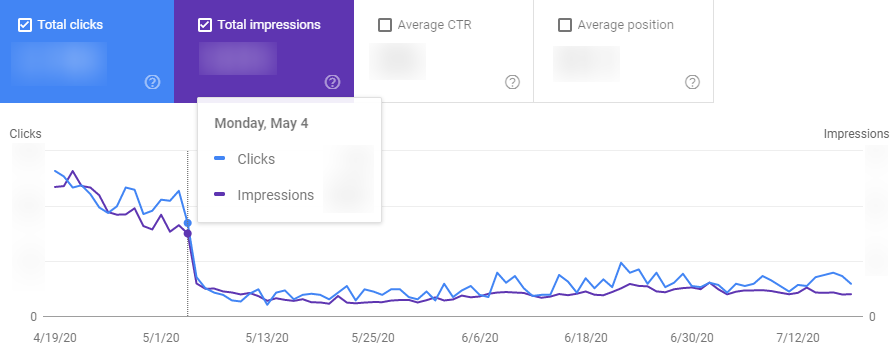
As we tried to understand which aspect of the update was driving down this client’s results, we realized something: one of the root causes was outdated, thin content.
We’re talking about blogs that are shorter in length and lack real value or relevant information.
Once we conducted a content pruning session, we realized that clicks and impressions began to level out at their regular levels.
However, as newer content becomes outdated in the next year or two, this process will need to happen again in order to keep impressions high.
As a rule of thumb, your team should likely plan to prune content on a bi-annual basis.
You’ll probably need to start with a large prune if you haven’t done so in years, but you can then switch to cleaning things up every six months or so.
According to SEMrush, 51% of companies claim that updating old content has proven to be among their most efficient tactics implemented for SEO.
If your website has more than 1K pages, you might need to prune every three or four months.
As you prune, keep an eye on your site’s analytics to understand where cleanup sessions best fit into your workflow.
The Benefits of Regular Content Pruning
Obviously, we believe that Google’s latest Core Update has sparked a dire need for regular content pruning.
Still, we encourage you to clean old content for other benefits besides the search engine’s approval.
Here are some of the big ones.
Enjoy Better Overall Quality
Who doesn’t want a website that’s better overall?
Lower the chances of users encountering embarrassing old content or information you’d no longer stand by.
Pruning ensures you’re proud of everything that’s on your website, not just the content you’re posting today.
Promote an Improved User Experience
When someone visits your website, you want them to immediately find the best information you have.
If you have fewer posts – but ones that you are happy to share – visitors will have an easier time locating the exact resource they need.
Link More Purposefully
Whether you’re linking to outside sources or internally, you want to link to good content.
Content pruning ensures that you’re only linking between authoritative pages that are worthwhile.
Increase Your Crawl Budget
When you prune your content, you are making life easier for Google bots to crawl your website.
By removing the “dead weight”, Google is able to index more of your content and make each crawl more meaningful.
As is a common theme in this post, carrying extra baggage on your website is going to pull you down as you work to gain rankings on the SERPs.
How to Conduct Content Pruning
Here’s how you can actually conduct the process of content pruning.
Step 1: Define What You’re Going to Audit
Some old content is evergreen, which means it’s still attracting organic traffic and shouldn’t be chopped.
However, it can certainly be updated with new stats, examples, and tips.
Other old posts, however, may be polluting your rank and clogging up your website with low-quality content.
As you begin your pruning process, determine which pages are indexed with Google and which will need to be evaluated.
Step 2: Identify Your Underperforming Pages
Once you have a good feel for your site’s structure and what’s still providing value, take note of the pages that seem to be performing poorly.
Whether they’re receiving only a few clicks or they’re no longer relevant to your site, it’s important to understand which pages are bogging your site down.
Go through each piece of content on your site and use your best judgement.
Step 3: Pull in Traffic & Backlink Data
Don’t just assume you know which pages are underperforming – conduct real analysis to understand traffic and backlinks.
Use metrics from Google Search Console and Google Analytics or your own analytics software.
Generally, if a piece of content hasn’t been getting any traffic/clicks in one to two years, it should be pruned.
Step 4: Decide Whether to Trash or Improve Posts
Now that you know which posts are problematic, it’s time to make some decisions.
You have two choices:
- To improve underperforming content.
- To drop the posts completely.
Either of these work – it’s up to you to decide if your old content is worth cleaning and updating.
Repurposing old content is a better use of time than starting from scratch, but it all depends on your team’s goals and workloads.
In some cases, though, you might be better off writing new content on similar subjects, but with more relevant and modern data.
Results from Proper Content Pruning
Let’s look at some results that the content pruning process brings.
We’re going to look at two big examples: HubSpot and a client we did some content pruning work for.
Take a look at how HubSpot got results from it.
The SEO giant deleted a whopping 3,000 old blog posts last year, and almost immediately, saw a spike in their clicks.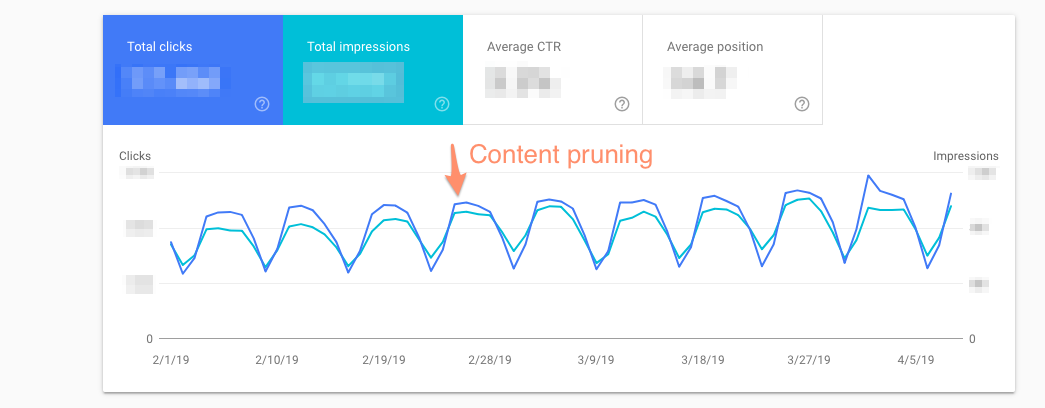
HubSpot is doing a lot right when it comes to optimizing for Google, like publishing new content and fixing technical issues.
However, it’s undeniable that their crawl budget has lowered, their clicks have risen, and indexing their site is faster than ever. This is most likely attributed to their content pruning.
Similarly, take a look at the results from one of our clients for which we carried out the content pruning process.
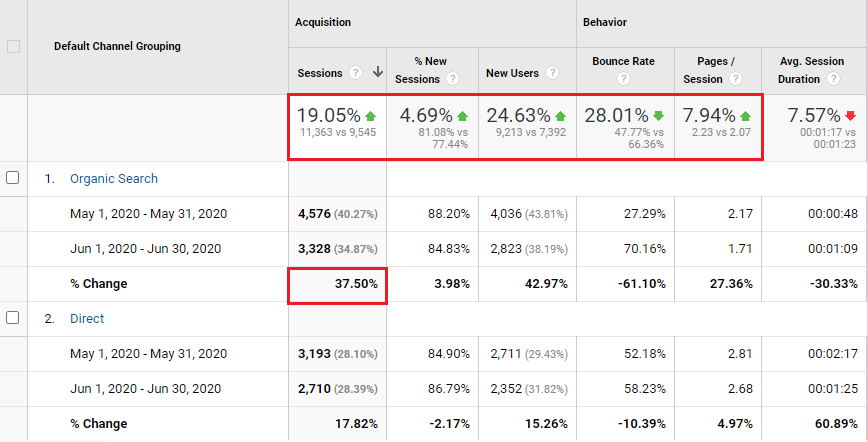
We saw a 37 % jump in organic traffic after their pruning process.
In just one month, our client was receiving more impressions and clicks than before the Google update and their subsequent clean out.
We could throw dozens of examples at you, but the point is, there are tons of websites seeing excellent results from pruning their content.
Don’t just take our word for it – conduct your own cleanup process to see how your organic traffic and impressions will change.
In Conclusion
Although some wonder if we have the math to truly decode Google’s algorithms, we know a few things.
Google is increasingly focused on accuracy, relevancy, and quality – as well as timeliness in information.
As we face more inaccurate information on the web than ever before, the search engine is working double-time to prioritize websites that keep their content fresh and reliable.
If you’re wondering how to adapt to the latest core update and your site has tons of content, our biggest suggestion is to content prune.
Cut that dead weight that’s been holding you back and make sure every part of your website complies with Google’s latest quality expectations.
More Resources:
- How & Why You Must Improve or Remove Your Old Content
- How to Find & Improve Underperforming Content: A Practical Guide
- The Essential Guide to Managing Expired Content
Image Credits
Featured Image: Created by author, July 2020
In-Post Image: HubSpot
All screenshots taken by author, July 2020
