

In this week’s edition of Ask An SEO, Mehmet from Adana, Turkey, writes:
“Hello there. I own a business that provides cleaning services and serves about 120 different neighborhoods.
I want to create a separate article for each of the city, district, neighborhood, and service searches. Is this the right local strategy and what should the link structure look like?”
Great question.
Your question refers to articles and link structure, so we’ll focus on that today.
But I want to make sure this isn’t your only local search strategy.
A comprehensive local SEO strategy is also going to include:
- Your Google Business Profile (formerly GMB) and other local listings on search engines, directories, etc.
- Local reviews monitoring and management.
- Local keyword research and localized content.
- Local link building.
- Paid search or social as needed to augment your organic performance.
Wherever customers are searching for services like yours, you want to be there and either convert them immediately or direct them to your desired URL to learn more.
So let’s talk about the idea of putting together a separate article for each city, district, neighborhood, and service.
Local Articles For Each Service & Area?
That sounds like a whole lot of work and not an awesome user experience for your prospective customers.
Articles and blog posts can be great top-of-funnel, informational pieces for generating awareness and getting your brand name out there.
They can be great for the consideration and evaluation stages, too, particularly in a long sales cycle or for big-ticket items.
Let’s think first of the intent of local searchers who may be looking for cleaning services, though.
Sure, you’re going to get some who are super curious about a certain type of service, how it works, what products are used, etc.
But many others who simply want to know things like:
- Are you open when I need you?
- How much will this cost?
- Do you service my area?
- Can I book a consultation?
- Do you have a location I can drop into?
- Who else has used your services?
- What do people say about working with you?
- How far are you away from where I need you to be?
- What types of equipment do you use?
- Do you have any specializations?
You don’t want to make them sift through 800+ words of a written article to find the simple answers that might immediately convert them to a booked appointment, phone call, or other desired action.
It’s also a massive task to come up with enough unique information about each location to produce an engaging, quality article about it.
If you have the budget (now or in the future) and want to invest in crafting content to meet various types of searcher intent in each region, that will be part of an excellent promotional strategy.
But you don’t want to use articles as your primary, catch-all destination for local searchers.
Use Local Landing Pages Instead
There are a lot more compelling ways to convey these answers than in an article.
An integrated map enables the searcher to gauge how far they are from the business location or whether you service their area.
An embedded video can give them a quick overview of your facility, equipment, techniques, and personnel.
Local reviews can showcase your most recent customer feedback and provide that social proof when and where they’re considering using your service.
High-quality photos can help them understand the experience you’re offering.
Local content and offers can serve your visitors’ informational and conversion needs.
Click to call, book, or contact functionality (or even live messaging) makes it easy for those ready to convert to do so.
These are all elements of a quality local landing page experience.
From here, you can link to your more in-depth resources.
And yes, you can definitely use your landing page template to create specialty pages for certain types of services, lines of business, etc.
What matters most is that your local pages are:
- Responsive.
- Optimized for both search and conversion.
- Built to provide the next steps for all different kinds of local searchers.
- Properly marked up with the relevant schema so Google understands how and why your page is the best answer for relevant queries.
See John McAlpin’s SEO Checklist to the Perfect Location Page for more tips on what makes a great local landing page.
Now, Get People To Your Local Pages
Use a locator to help searchers find the right location. Linking back to the locator ensures that customers can get back and explore other locations and services, as well.
Your locator can live in the main menu and be featured on the homepage, and each local page is just a couple of clicks away.
Breadcrumbs are a good navigational tool here.
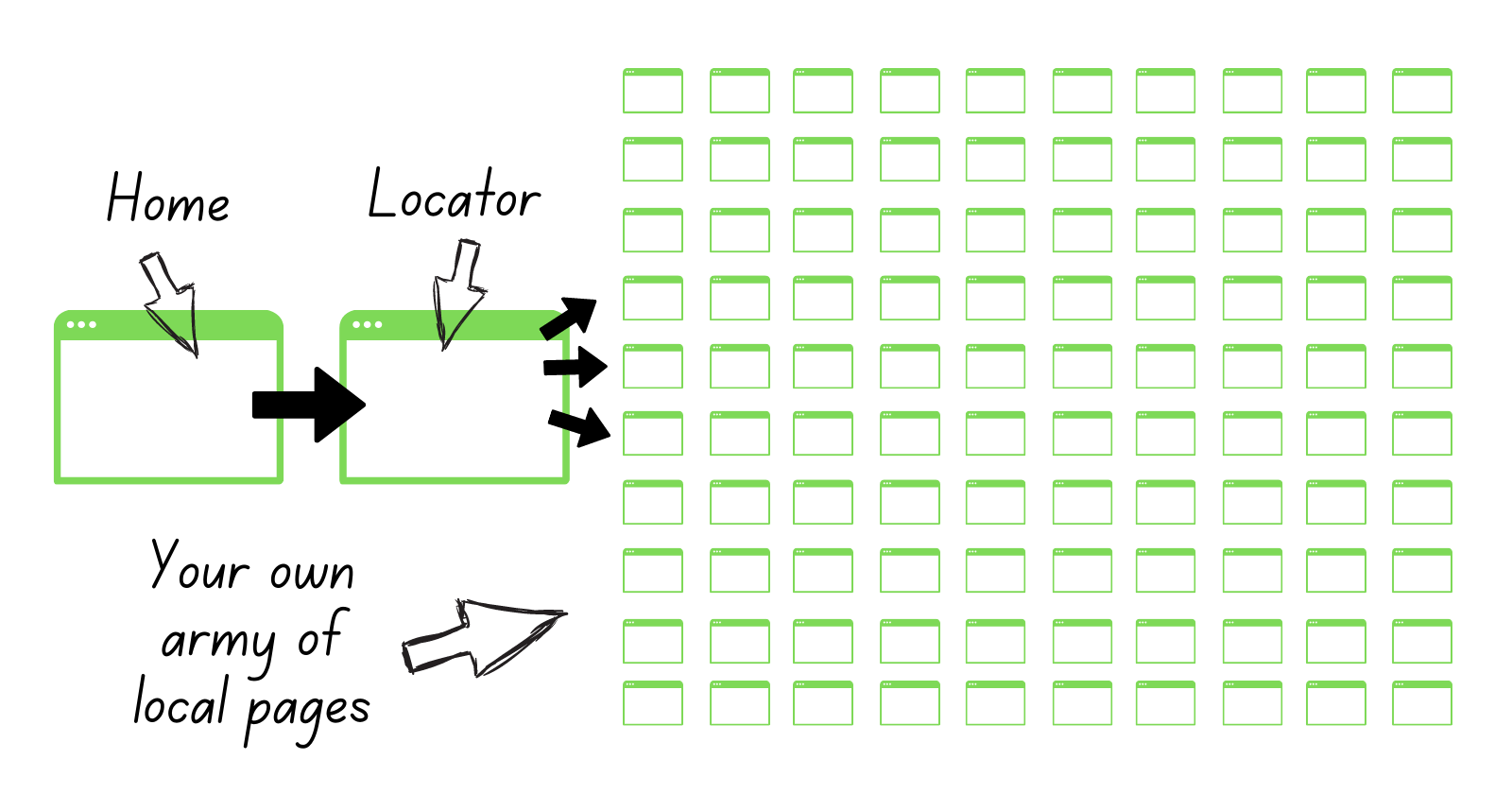
You can use a template for your local pages to keep the look, feel, and experience consistent as well as reducing the workload in producing them.
Duplicate content will not impact your rankings, so don’t worry if these are generic at first and you add localized content over time as you can.
Refer to local landmarks and cross streets, share photos of the interior and exterior, explain any special services offered out of that location, etc.
Link to the appropriate local page from each Google Business Profile and online listing, as well. It’s a far better user experience than sending people from a localized search to your homepage.
Look at who else is ranking organically and locally on the terms you want to dominate. These could be competitors, information portals, local community organizations and media, directories, social content, and more.
Ask yourself:
- Can I outrank them?
- Can I get listed or advertise with them?
- Can I get them to link to my site?
If you can’t find a way to appear organically or in the top 3 MapPack results, you may want to run a local PPC campaign directing people to the relevant page for that geographic area.
You can also use articles and blog posts to feed those more informational queries and direct people to your locator to find the location nearest them.
Check out 8 Ways To Drive Local Business In Competitive Markets With Search and watch our Proven Local Marketing Strategies to Drive Customer Experience & ROI webinar on-demand for more tips.
Get Systems and Processes In Place to Manage Your Growing Presence
Finally, you have some additional challenges as a multi-location, service-area business.
Creating all of this content and these landing pages is one thing.
But you must then be able to keep it all accurate, measure engagement and performance, and make edits and updates, as well.
Even changing your hours for the holidays becomes a big deal when you have to do it across 120 Google profiles and local landing pages.
Plus, all kinds of inaccuracies are introduced to local listings by data aggregators using outdated information, Google users suggesting edits, ownership conflicts, and more.
It wouldn’t hurt to look into some local SEO tool and platform options to make easier work of this.
Contrast the expense of the tool against the labor you’ll save and the business benefits of improving your local SEO performance at this scale.
Building your local presence isn’t quick work. But if you can automate some of the work of monitoring, updating, and finding new opportunities to appear, you’ll be that much further ahead.
More resources:
- The Complete Guide to Local SEO for Multiple Locations
- 15 Local SEO Mistakes and How to Avoid Them
- Local SEO: The Definitive Guide to Improve Your Local Search
Ask An SEO is a weekly SEO advice column written by some of the industry’s top SEO experts, who have been hand-picked by Search Engine Journal. Got a question about SEO? Fill out our form. You might see your answer in the next #AskanSEO post!
Featured image: Shutterstock/milo827
