<?xml version="1.0" encoding="utf-8"?><rss version="2.0"
	xmlns:content="http://purl.org/rss/1.0/modules/content/"
	xmlns:dc="http://purl.org/dc/elements/1.1/"
	xmlns:atom="http://www.w3.org/2005/Atom"
	xmlns:sy="http://purl.org/rss/1.0/modules/syndication/"
		>
<channel>
	<title>Comments on: How to Analyze a Page HTML Semantic&#160;Structure</title>
	<atom:link href="http://www.searchenginejournal.com/how-to-analyze-a-page-html-semantic-structure/7515/feed/" rel="self" type="application/rss+xml" />
	<link>http://www.searchenginejournal.com/how-to-analyze-a-page-html-semantic-structure/7515/</link>
	<description></description>
	<lastBuildDate>Tue, 14 Feb 2012 17:43:21 +0000</lastBuildDate>
	<sy:updatePeriod>hourly</sy:updatePeriod>
	<sy:updateFrequency>1</sy:updateFrequency>
	<generator>http://wordpress.org/?v=</generator>
	<item>
		<title>By: David Radovanovic</title>
		<link>http://www.searchenginejournal.com/how-to-analyze-a-page-html-semantic-structure/7515/comment-page-1/#comment-1114310</link>
		<dc:creator>David Radovanovic</dc:creator>
		<pubDate>Tue, 22 Sep 2009 14:30:55 +0000</pubDate>
		<guid isPermaLink="false">http://www.searchenginejournal.com/how-to-analyze-a-page-html-semantic-structure/7515/#comment-1114310</guid>
		<description>Ann,

Thanks for the SEO tid bit. Some of us don&#039;t place enough emphasis on correct page (html) structure and its importance in SEO.</description>
		<content:encoded><![CDATA[<p>Ann,</p>
<p>Thanks for the SEO tid bit. Some of us don&#8217;t place enough emphasis on correct page (html) structure and its importance in SEO.</p>
]]></content:encoded>
	</item>
	<item>
		<title>By: TOp4office</title>
		<link>http://www.searchenginejournal.com/how-to-analyze-a-page-html-semantic-structure/7515/comment-page-1/#comment-1097342</link>
		<dc:creator>TOp4office</dc:creator>
		<pubDate>Wed, 01 Apr 2009 15:56:13 +0000</pubDate>
		<guid isPermaLink="false">http://www.searchenginejournal.com/how-to-analyze-a-page-html-semantic-structure/7515/#comment-1097342</guid>
		<description>I have a slight suspicion that they do affect the ranking of the website. H1 is usually used to determining what the page is about and should normally keyword phrases.</description>
		<content:encoded><![CDATA[<p>I have a slight suspicion that they do affect the ranking of the website. H1 is usually used to determining what the page is about and should normally keyword phrases.</p>
]]></content:encoded>
	</item>
	<item>
		<title>By: Ann Smarty</title>
		<link>http://www.searchenginejournal.com/how-to-analyze-a-page-html-semantic-structure/7515/comment-page-1/#comment-1084297</link>
		<dc:creator>Ann Smarty</dc:creator>
		<pubDate>Wed, 20 Aug 2008 17:40:07 +0000</pubDate>
		<guid isPermaLink="false">http://www.searchenginejournal.com/how-to-analyze-a-page-html-semantic-structure/7515/#comment-1084297</guid>
		<description>@Michael : I guess we are talking about two different things... I was referring to HTML semantic structure, not semantic structure in its broad meaning...</description>
		<content:encoded><![CDATA[<p>@Michael : I guess we are talking about two different things&#8230; I was referring to HTML semantic structure, not semantic structure in its broad meaning&#8230;</p>
]]></content:encoded>
	</item>
	<item>
		<title>By: Web Agency Chieti</title>
		<link>http://www.searchenginejournal.com/how-to-analyze-a-page-html-semantic-structure/7515/comment-page-1/#comment-1084296</link>
		<dc:creator>Web Agency Chieti</dc:creator>
		<pubDate>Wed, 20 Aug 2008 16:04:27 +0000</pubDate>
		<guid isPermaLink="false">http://www.searchenginejournal.com/how-to-analyze-a-page-html-semantic-structure/7515/#comment-1084296</guid>
		<description>@Micheal

To be more precise, doing semantic HTML mean use markup correctly, and it&#039;s not dependend by the word arrangement at all.
If you have a heading use the heading element, beginning with the H1 element. If you have a paragraph, use a paragraph element. If you have a list, use a list item element. yadda yadda yadda</description>
		<content:encoded><![CDATA[<p>@Micheal</p>
<p>To be more precise, doing semantic HTML mean use markup correctly, and it&#8217;s not dependend by the word arrangement at all.<br />
If you have a heading use the heading element, beginning with the H1 element. If you have a paragraph, use a paragraph element. If you have a list, use a list item element. yadda yadda yadda</p>
]]></content:encoded>
	</item>
	<item>
		<title>By: Michael Martinez</title>
		<link>http://www.searchenginejournal.com/how-to-analyze-a-page-html-semantic-structure/7515/comment-page-1/#comment-1084295</link>
		<dc:creator>Michael Martinez</dc:creator>
		<pubDate>Wed, 20 Aug 2008 15:56:35 +0000</pubDate>
		<guid isPermaLink="false">http://www.searchenginejournal.com/how-to-analyze-a-page-html-semantic-structure/7515/#comment-1084295</guid>
		<description>Semantic structure refers to the arrangement of words, not to how they are marked up in HTML.  Search engines are still using primitive semantic algorithms that are not likely to be influenced by whether you break your copy up with section headers.

In semantic analysis you look for relationships between words and groups of words.  If you can identify patterns you&#039;ll be able to notice triggers that allow acceptable substitutions.

We&#039;ve already begun to see these kinds of substitutions in suggested alternative searches and in the variant copy expressions that appear in relevant search results (as opposed to irrelevant copy expressions that have always appeared in poorly organized queries).

We&#039;re not yet to the point where a query like &quot;canine trainer&quot; produces results similar to the &quot;dog trainer&quot; query, but when we get there it won&#039;t be because of HTML markup.</description>
		<content:encoded><![CDATA[<p>Semantic structure refers to the arrangement of words, not to how they are marked up in HTML.  Search engines are still using primitive semantic algorithms that are not likely to be influenced by whether you break your copy up with section headers.</p>
<p>In semantic analysis you look for relationships between words and groups of words.  If you can identify patterns you&#8217;ll be able to notice triggers that allow acceptable substitutions.</p>
<p>We&#8217;ve already begun to see these kinds of substitutions in suggested alternative searches and in the variant copy expressions that appear in relevant search results (as opposed to irrelevant copy expressions that have always appeared in poorly organized queries).</p>
<p>We&#8217;re not yet to the point where a query like &#8220;canine trainer&#8221; produces results similar to the &#8220;dog trainer&#8221; query, but when we get there it won&#8217;t be because of HTML markup.</p>
]]></content:encoded>
	</item>
	<item>
		<title>By: Web Agency Chieti</title>
		<link>http://www.searchenginejournal.com/how-to-analyze-a-page-html-semantic-structure/7515/comment-page-1/#comment-1084289</link>
		<dc:creator>Web Agency Chieti</dc:creator>
		<pubDate>Wed, 20 Aug 2008 15:21:39 +0000</pubDate>
		<guid isPermaLink="false">http://www.searchenginejournal.com/how-to-analyze-a-page-html-semantic-structure/7515/#comment-1084289</guid>
		<description>@WebSite Design Orange County  
What&#039;s the matter? Did you get something wrong today, or simply slept without sheets into the blowing wind? :)</description>
		<content:encoded><![CDATA[<p>@WebSite Design Orange County<br />
What&#8217;s the matter? Did you get something wrong today, or simply slept without sheets into the blowing wind? :)</p>
]]></content:encoded>
	</item>
	<item>
		<title>By: WebSite Design Orange County</title>
		<link>http://www.searchenginejournal.com/how-to-analyze-a-page-html-semantic-structure/7515/comment-page-1/#comment-1084288</link>
		<dc:creator>WebSite Design Orange County</dc:creator>
		<pubDate>Wed, 20 Aug 2008 15:11:55 +0000</pubDate>
		<guid isPermaLink="false">http://www.searchenginejournal.com/how-to-analyze-a-page-html-semantic-structure/7515/#comment-1084288</guid>
		<description>&quot;U&quot; is NOT a word! 

It takes .0005 seconds to actually type the word &quot;You&quot;, it&#039;s not that hard. Let&#039;s not let intelligence and grammar fall into the abyss of laziness.</description>
		<content:encoded><![CDATA[<p>&#8220;U&#8221; is NOT a word! </p>
<p>It takes .0005 seconds to actually type the word &#8220;You&#8221;, it&#8217;s not that hard. Let&#8217;s not let intelligence and grammar fall into the abyss of laziness.</p>
]]></content:encoded>
	</item>
	<item>
		<title>By: Web Agency Chieti</title>
		<link>http://www.searchenginejournal.com/how-to-analyze-a-page-html-semantic-structure/7515/comment-page-1/#comment-1084280</link>
		<dc:creator>Web Agency Chieti</dc:creator>
		<pubDate>Wed, 20 Aug 2008 12:36:36 +0000</pubDate>
		<guid isPermaLink="false">http://www.searchenginejournal.com/how-to-analyze-a-page-html-semantic-structure/7515/#comment-1084280</guid>
		<description>@Jaan 

Unfortunately I actually deleted my test pages, but I can assure u, as probably most of us that a document with an H1 is heavy than one with H3. 
A starting doc.

You can do a stupid test if u want. Create two new pages, same content, same title. One with h1, and one with h3. Link both of them to an index of a dir that is new.
In yout content or title write an absurd word that u and only u know (ex. thsstestforhtmlhedtag) and submit to google. wait some days and then try to look for that occurence and see the serp order. 
That&#039;s all.</description>
		<content:encoded><![CDATA[<p>@Jaan </p>
<p>Unfortunately I actually deleted my test pages, but I can assure u, as probably most of us that a document with an H1 is heavy than one with H3.<br />
A starting doc.</p>
<p>You can do a stupid test if u want. Create two new pages, same content, same title. One with h1, and one with h3. Link both of them to an index of a dir that is new.<br />
In yout content or title write an absurd word that u and only u know (ex. thsstestforhtmlhedtag) and submit to google. wait some days and then try to look for that occurence and see the serp order.<br />
That&#8217;s all.</p>
]]></content:encoded>
	</item>
	<item>
		<title>By: Jaan Kanellis</title>
		<link>http://www.searchenginejournal.com/how-to-analyze-a-page-html-semantic-structure/7515/comment-page-1/#comment-1084276</link>
		<dc:creator>Jaan Kanellis</dc:creator>
		<pubDate>Wed, 20 Aug 2008 11:47:19 +0000</pubDate>
		<guid isPermaLink="false">http://www.searchenginejournal.com/how-to-analyze-a-page-html-semantic-structure/7515/#comment-1084276</guid>
		<description>I understand the analogies and the reasoning, but did anyone test this in a thread to know if it makes even the slightest bit of difference at all?</description>
		<content:encoded><![CDATA[<p>I understand the analogies and the reasoning, but did anyone test this in a thread to know if it makes even the slightest bit of difference at all?</p>
]]></content:encoded>
	</item>
	<item>
		<title>By: g1smd</title>
		<link>http://www.searchenginejournal.com/how-to-analyze-a-page-html-semantic-structure/7515/comment-page-1/#comment-1084270</link>
		<dc:creator>g1smd</dc:creator>
		<pubDate>Wed, 20 Aug 2008 09:35:06 +0000</pubDate>
		<guid isPermaLink="false">http://www.searchenginejournal.com/how-to-analyze-a-page-html-semantic-structure/7515/#comment-1084270</guid>
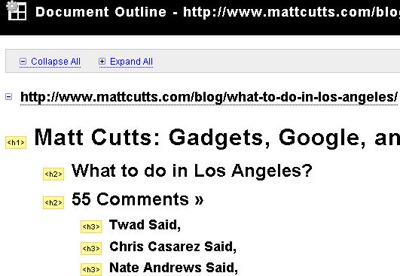
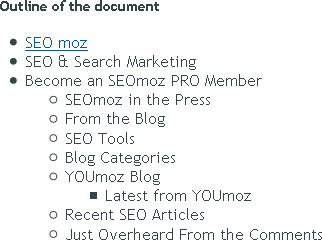
		<description>The numbers show relative importance, and say nothing as to how those should be visually rendered. 

However, you should generally start at H1 for the most important, and work down for the rest. 

CSS takes care of what they look like on screen.  :-)</description>
		<content:encoded><![CDATA[<p>The numbers show relative importance, and say nothing as to how those should be visually rendered. </p>
<p>However, you should generally start at H1 for the most important, and work down for the rest. </p>
<p>CSS takes care of what they look like on screen.  :-)</p>
]]></content:encoded>
	</item>
</channel>
</rss>