

AI has pushed all the chips in for PR.
Everyone is clamoring for news coverage (linked and unlinked), and AI has made it easier to find and spam journalists.
In this post, I’ll show you why the landscape is very different from what it used to be, based on four major studies I published, including 14.3 million emails by domain age, 39 million emails by subject line, 628 AI summaries, and data on the journalist workforce.
I’ll focus on four areas: journalist attention, domain optimization, subject lines, and AI summaries.
1. Fewer Journalists, More PR Pros
In the AI era, there are a LOT more PR professionals in the space than ever before and they outnumber journalists.
In the U.S., I estimated about two or three PR pros for every one journalist (though our research showed a big discrepancy based on where you look: the U.S. Census says 1.8; the Bureau of Labor Statistics says 7.2). In the U.K., it’s roughly 1.5 pros per journalist.
Now, take all those PRs and add the fact that many link builders are also migrating to PR as an inroad to AI exposure.
AI-generated pitches, even fake experts, now flood the market, and journalists are underwater with irrelevant AI slop pitches.
We are seeing this playing out in the data as well. Muck Rack’s State of Journalism 2026 found that 47% of journalists say they seldom or never receive pitches that match what they cover!
What can you do about it?
You are going to hear this a lot from me, but it all comes down to quality over quantity.
Finding the right journalist for a campaign means going beyond a bio or job title and looking at what they actually cover.
Look at an author page and gauge relevance by the last 10-20 articles they’ve written.
2. Domain Optimization Is More Impactful Than You Think
I thought things like domain age or email authentication were throwaway factors until I looked at the data.
But they can drastically change whether or not an email even lands in a journalist’s inbox.
Like Google’s search algorithm, we don’t know what goes into email deliverability or how email platforms gauge sender reputation, but we do have data that can provide directional guidance.
Domain Age
Based on our study, older domains (5-6 years old) got better open rates (34.9%) on average than domains 1-2 years old (21.6%).
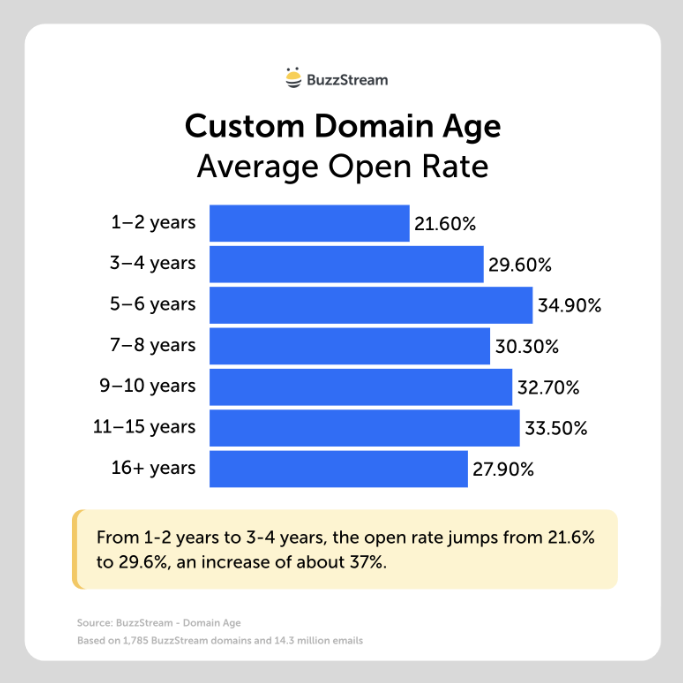
I thought at first that the older domains just had more experienced senders, but both seasoned digital PR practitioners and brand-new accounts had equally low opens with a new domain, around 25%.
Young domains with full SPF/DKIM/DMARC still averaged 17.9% open rates.
What can you do about it?
Unfortunately, you can’t shortcut this.
While you’re building domain age, you still need to maintain proper emailing practices throughout, which again comes back to quality vs. quantity.
SPF/DKIM/DMARC Authentication
SPF/DKIM/DMARC authentication is essentially a set of rules that tells email providers how to handle emails and senders.
In a study we conducted on 1,588 sending domains, we found that fully authenticated domains got almost 4x better open rates (30.1% avg. open rate) than unauthenticated domains (7.8% avg. open rate).
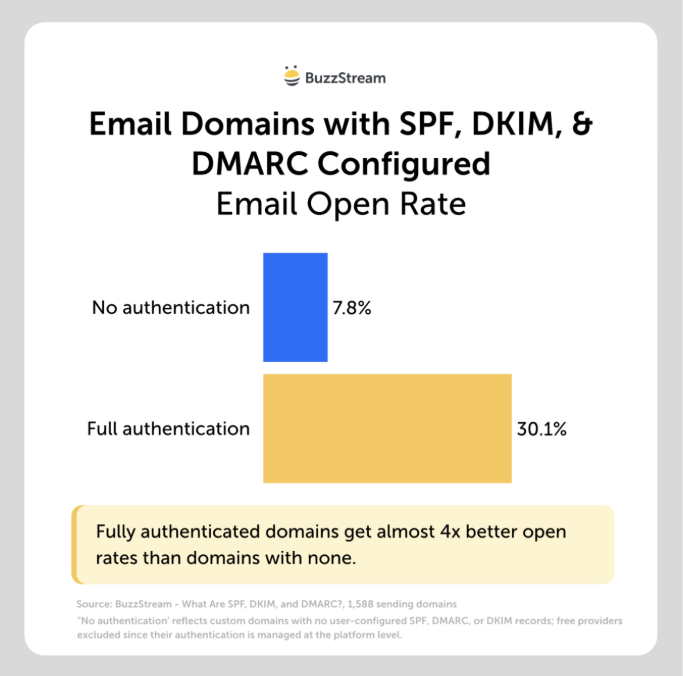
Proper SPF, DKIM, and DMARC authentication has become much more important as providers fight against spam.
Google and Yahoo rolled out new sender requirements in 2024, followed by Microsoft a year later. Missing them can get you blocked (which we’ve actually seen happen to BuzzStream customers).
What can you do about it?
This one is pretty easy to fix.
SPF, DMARC, and DKIM records are located in your domain’s DNS settings.
Typically, a developer can tackle these in under an hour.
AI tools can also easily walk you through it (they helped me do it in just a few minutes).
If you’re curious where yours stand, I built a free checker for this.
3. Subject Line Is King
The subject line is the true differentiator these days for standing out in a journalist’s crowded inbox.
Here’s a screenshot of an inbox from U.K.-based freelance journalist Rosie Taylor:
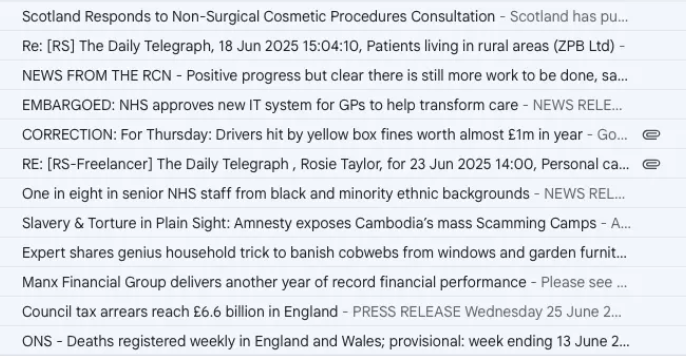
Imagine trying to find a relevant piece of coverage while swimming through a sea of irrelevant emails, marketing emails, and AI-written emails.
That said, I recently published two big subject line studies that I think show you how to stand out.
State The Finding, Concretely
Journalists don’t need clickbait.
Lines that stated a finding (e.g., Raleigh Among Best for New Homeowners) got 43.1% opens and 1.37% replies.
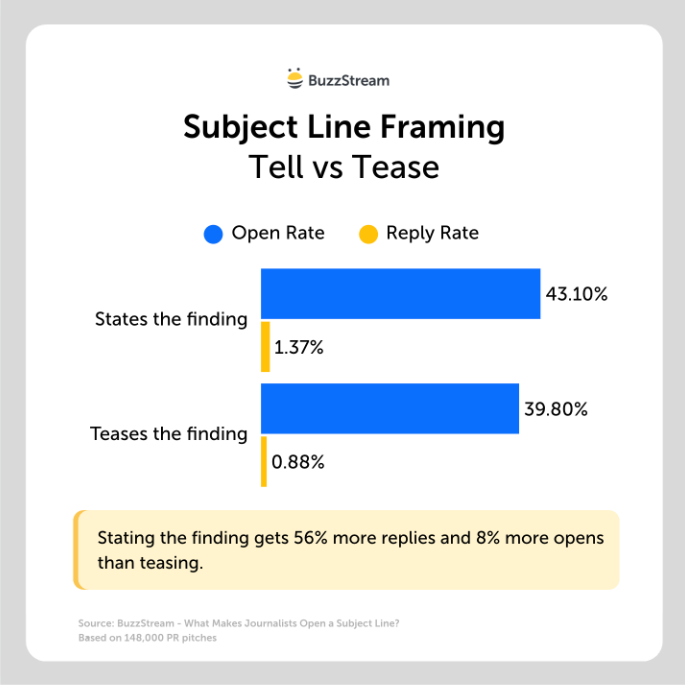
Subject lines that teased a finding (e.g., Which City is Best for New Homeowners?) got 39.8% opens and 0.88% replies.
Similarly, we found that concrete subject lines (e.g., Raleigh Ranked #1 City for New Homeowners) got 43% open rates and performed better than vague ones (34.6%) (e.g., New Study on the Housing Market).
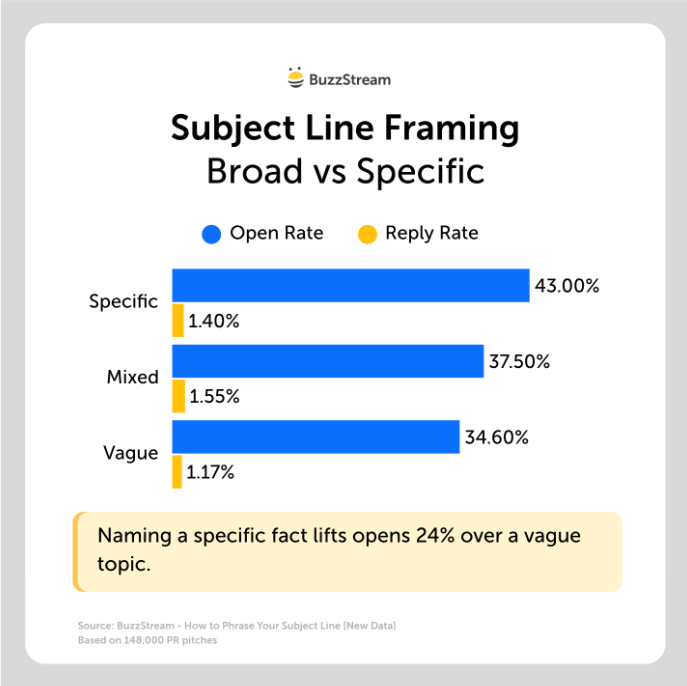
You can start to see a pattern here: it’s all about specifics.
What can you do about it?
Write the main takeaway out as a sentence first, then start rearranging.
When you’re done, put yourself in the shoes of a journalist and ask yourself:
- Does my subject line highlight the most important takeaway in the whole piece?
- Am I being specific enough?
Hone it in. Ask your friends, colleagues, even AI for some feedback.
Front-Load The First 3 Words
In the same study, subject lines that put the key stat or information in the first 1-3 words got 46% open rates, compared to those in words 4-6 (38.9%).
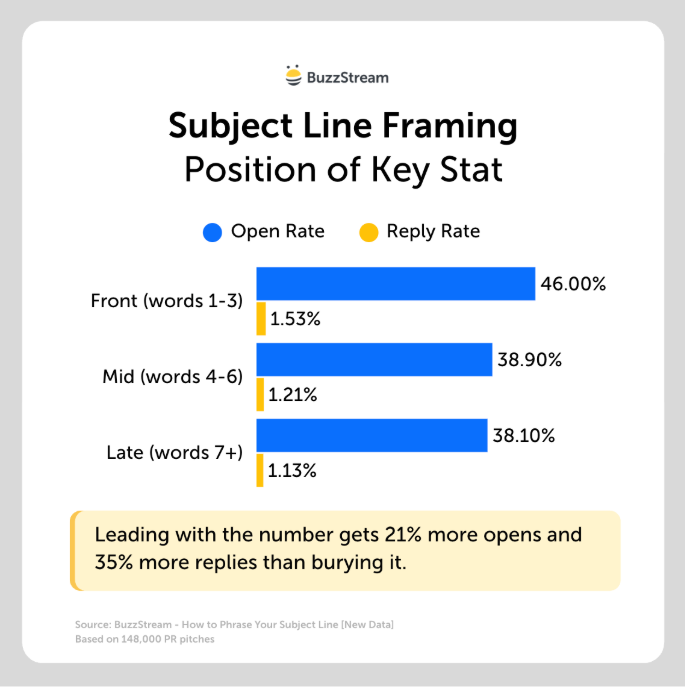
Word placement matters because of email subject-line character limits.
Every email platform has its own limits, and they differ.
Roughly ~60 characters on desktop and ~42 on mobile is the sweet spot, but it varies greatly.
What can you do about it?
Think about delivering the key stat as succinctly and quickly as possible.
This might mean flip-flopping your subject lines.
Instead of “Best City for Homeowners is Raleigh,” you start with what will be most eye-catching and applicable to your target journalist: “Raleigh Named Best City for Homeowners.”
Test it out in your own email provider to see how it gets cut off.
4. AI Inbox Summaries Are Reading Your Pitches
Gmail, Apple, and Microsoft all now have AI summaries that appear at the top of email messages, changing how journalists may perceive your message.
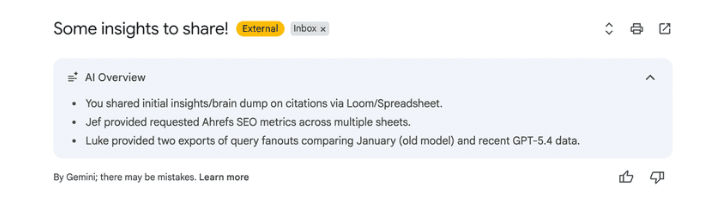
In a study we did with digital PR agency Aira, we uncovered some tendencies in how these platforms summarized, and more importantly, where they pulled information from.
Front-Load Key Info In The Email Body
In general, content from the first half of emails appeared more frequently in AI summaries across Apple, Google, and Microsoft email platforms.
87.1% of Google’s AI-generated summary content came from the first half of the email. Apple: 82.5%, and Microsoft: 65.4%.
AI-Generated Email Summary Keyword Matches By Position*
| Platform | Early % | Late % |
| 87.1% | 12.9% | |
| Apple | 82.5% | 17.5% |
| Microsoft | 65.4% | 34.6% |
*Data from Buzzstream and Aira AI-Generated Email Study
(In general, Microsoft was a little more spread out because their AI summaries tended to be around 150 words long, compared to Google’s 30 and Apple’s 50.)
This aligns with other studies showing that AI tools are more likely to pull information from the beginning of a page.
What can you do about it?
Personalize who you pitch, not the opening line.
If your story and email are relevant enough for your target journalist, the personalization isn’t necessary.
Lines like “I read your previous article on X, and found Y” don’t seem to have the impact that they used to, which makes sense given how time-crunched everyone is.
In fact, in our study, personalized intros were mostly not included in Google’s (11% of the time) or Apple’s (0%) AI summaries.
(Microsoft had the highest chance of inclusion at 61%, but again Microsoft has longer summaries, so it makes sense they would include more.)
Use Bulleted Information
Another big takeaway for me was that, across all platforms, bulleted text influenced AI summaries at least 64% of the time.
AI-Generated Email Summary Bulleted Text Inclusion Rate*
| Platform | Inclusion Rate |
| 65% | |
| Apple | 64% |
| Microsoft | 92% |
*Data from Buzzstream and Aira AI-Generated Email Study
Microsoft included information from the bullets 92% of the time, followed by Google (65%) and Apple (64%).
What can you do about it?
I’ve always been told that bullets should support the main takeaway.
So if your takeaway that “Raleigh was named the best city for homeowners” appeared in the opening section of your email body, you don’t need to repeat it in the bullets.
Instead, the bullets should help explain more of the why and how.
It could be things like:
- Ranked first in median home price at $350,000.
- Ranked second in property tax.
- Ranked third in schools.
Digital PR expert Hannah Smith of Worderist once suggested on our podcast that I try to write an article from a PR pitch I wrote.
When writing your bullets, put most of the key info that helps fill out the article there.
If you’re following that, the AI summaries should pick up the most important information anyway.
Read Your Coverage
Although this won’t help you get coverage, it’s important to know that Apple and Microsoft AI summaries misrepresented information from the original email in about one in three summaries.
They mainly misrepresented data and expert quotes. So, when you do get coverage, double-check that it’s properly represented.
This is good practice in general, but even more so in the AI age.
Nothing Beats Relevance
In many ways, these are the same challenges we’ve always faced when getting a pitch read, but AI has supercharged everything and added a new one: AI summaries.
But if you can take one thing from this data, it’s that a good story isn’t enough anymore.
The good news is that focusing on relevance will help at every step.
Pitching the right journalist can protect your sender reputation.
Knowing what they cover makes it easier to write a subject line.
Writing a clear, direct pitch is far less likely to get slopped up by AI in a summary.
You can optimize all you want, but if you aren’t reaching the right journalists, you are doing yourself a disservice.
Not only do you risk spam complaints, but you add to the noise that’s making all of this harder in the first place.
More Resources:
- Ask An SEO: Digital PR Or Traditional Link Building, Which Is Better?
- Why Digital PR Fundamentals Beat AI Tactics: What Marketing Leaders Should Focus On
- An Easy Digital PR Strategy For AI SEO
Featured Image: Spiximcreation/Shutterstock
