
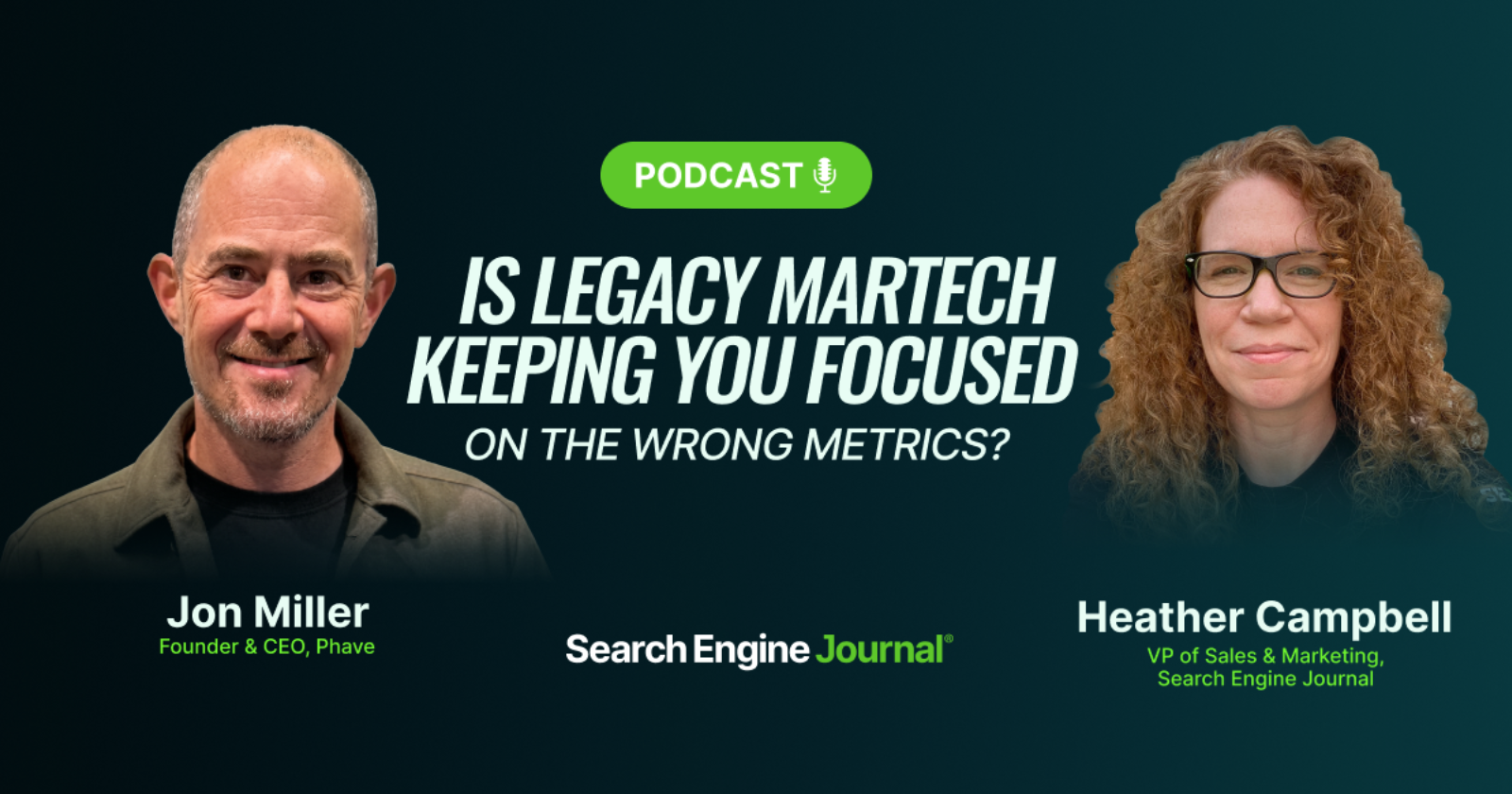
Is your marketing automation platform helping you grow, or making it harder to adapt? Jon Miller, co-founder of Marketo, Engagio, and Phave, joined me on the SEJ Podcast to discuss where he believes legacy marketing systems fall short and how AI could change the way B2B teams work.
In our conversation, Miller explained why individual leads and company accounts can miss the complexity of buying groups, how campaign queues and extra tools can signal gaps in your platform, and the difference between AI that builds rules-based workflows and AI that makes decisions. He also shares why marketers should review renewal dates early and think carefully before committing to a multi-year contract.
Watch the podcast:
[00:40] Meet Jon Miller
[01:26] Why Miller Built Phave
[04:25] Rethinking The B2B Marketing Playbook
[06:11] Moving From Rules To AI Reasoning
[07:58] Why Buying Groups Matter
[09:40] Signs Your Marketing Stack Is Holding You Back
[12:47] AI That Builds Automation Versus AI That Is The Automation
[15:20] Reviewing Your Platform Before Renewal
[17:09] Where To Find Jon Miller
Editor’s Note: This transcript has been edited for clarity and readability.
Meet Jon Miller
Heather Campbell: Thanks so much for joining us for today’s SEJ Podcast. I am your host, Heather Campbell, and I’ve got a guest who helped build the tools most of us have been running our marketing on for the last 20 years.
With me is Jon Miller. He is one of the people who invented the modern B2B marketing stack, and now he’s trying to replace it. I thought having him on our podcast would help marketing leaders take a look at whether the platforms you’re running could be causing gaps in the insights and data you need to grow your business.
Jon co-founded Marketo and was its CMO. He helped take it to a billion-dollar IPO, and the company went on to a $4.7 billion sale to Adobe. Then he did it again: He founded Engagio in 2015, an account-based marketing platform acquired by Demandbase in 2020, and ran their marketing through 2023.
Jon knows a thing or two about growth, and growth is where so many marketers and business leaders are stuck right now. That’s why I wanted to have you on the show. Jon, welcome.
Jon Miller: Thank you.
Why Miller Built Phave
Heather: As I learned about you and Phave.com, the newest platform you’ve just released, it’s barely even three weeks ago, right?
Jon: Yeah.
Heather: Tell us about what you saw breaking in traditional martech tools that made you want to compete with your own creation, thinking about Marketo. What gaps in current martech meant we marketers needed something new? What were you seeing?
Jon: First off, I love the name Phave for the company because it has such a positive association and it’s very short. The problem is I have to tell you how to spell it, which I think a search-focused audience might appreciate. It’s Phave with a PH: P-H-A-V-E.
With every other company, I’ve focused on wanting you to know how to spell it. Marketo and Engagio were pretty clear. I considered calling this company Conducto to put it into the same family, but ultimately decided Phave was better.
We launched Phave just over two and a half weeks ago after being in stealth for a while. For those who don’t know, Phave is AI-native marketing automation. It’s meant to replace legacy marketing automation platforms like Marketo, HubSpot, Eloqua, and Pardot.
As you alluded to, over 20 years ago, I was the founder of one of those platforms, Marketo. I’m proud of what we built. So many people come up to me who have literally built their careers on Marketo. That gives me such a positive feeling.
At the same time, when I decided to start a new company and was talking to people during my research, so many expressed frustration with the legacy platforms, using words like “necessary evil” to describe them.
I realized there was a lot of latent frustration with the lack of innovation in the category, especially since Marketo went to Adobe, Eloqua went to Oracle, and Pardot went to Salesforce.
People weren’t really moving on. There wasn’t much platform switching because there wasn’t anything worth switching to, and nobody likes a migration. So I set out to build it.
Rethinking The B2B Marketing Playbook
Jon: I didn’t want to build something a little better. Nobody is going to migrate for something a little better. There were two key principles behind Phave.
First, I wanted to build something for what I call the new B2B playbook. We built Marketo and the other systems for a fairly simplistic model of marketing: Maybe you have an ebook, get people to fill out a form, capture their information, nurture and score them, and pass them to sales at the right time.
It was very focused on new business acquisition and meant to be measurable within this simple, linear machine. That doesn’t reflect how buying works today. I’m not sure it ever really reflected how buying worked.
We know there are complex buying committees. Buying isn’t happening through one person.
Heather: Absolutely.
Jon: We know a lot of that buying committee is doing research anonymously across channels that are hidden or dark to us. We know the initial land is usually just a small fraction of the total deal value, and we need to do post-sale marketing to retain and expand the relationship.
In many ways, tools like Marketo weren’t built for any of that. When I talk about the new playbook, I mean something that works the way marketing needs to work today.
Moving From Rules To AI Reasoning
Jon: That leads to the second principle: AI. AI has dramatically changed both how buyers buy and how we can market to them, and what’s possible.
With Phave, we set out not just to add AI to a marketing automation platform, but to reimagine what a marketing automation platform should be when you have access to modern reasoning AI models.
This lets us move from a world of if-then rules to AI that can think and reason. Rules have a place. They’re good at things that must be true, like “Don’t email someone in Germany if you don’t have double opt-in consent.”
Heather: Right.
Jon: Rules are bad at handling ambiguity and judgment. The reality is that B2B buying is full of ambiguity and judgment.
Think of all the things we do in a marketing platform: What should this person’s score be? Are they sales-ready? What segment should they belong in? Which rep should I route them to? All the way down to: What actions should I take with this person to move her and her buying group toward an objective I’m trying to achieve?
That requires handling ambiguity, judgment, and reasoning, which rules cannot do. That’s the big unlock. Phave in five minutes: new playbook, AI reasoning, not rules.
Why Buying Groups Matter
Heather: One thing I was drawn to was your statement that leads are too narrow and companies, or accounts, are too broad.
With all the personalization we can do, and knowing that personalization helps move people down the funnel, I like looking at them as buying groups. You have different levels and roles within an organization. That helps you take personalized messaging and give it to the person in that role, wherever they are in the pipeline and their stage right now.
Jon: There are a couple of aspects to where buying groups really matter. You’re referring to understanding each person’s role and persona in the buying group, which is absolutely important.
The other thing is recognizing which product or solution that buying group is about, because that also determines what they’ll find relevant. But the most important thing is: Where is that buying group in its unique journey with you?
The problem with traditional ABM, for example, is that an account buys a product from you, so you call that account a customer. If you market to everybody in the account as though they’re a customer, you’ll be doing the wrong thing for people in buying groups that are buying other products or are at a different stage of the journey.
That’s why buying groups are the right object for B2B, and why leads are too narrow, and accounts are too broad.
Signs Your Marketing Stack Is Holding You Back
Heather: Organizations depend on the data their marketing technology gives them: the insights and dashboards they’ve leaned on for so many years.
For businesses still running on a legacy stack and relying on those, what gaps could it be creating that they’re not aware of? What should they look out for, and why might they want to switch to a different platform and get out of that legacy mindset?
Jon: I’ve seen marketers suffer from what I call “marketing automation Stockholm syndrome.” They’ve had to learn to live with the quirks and idiosyncrasies of these platforms. They take it for granted that this is how things are. When exposed to another way of doing things, their first reaction is, “But that’s not the way things are.”
Your question is: What should prompt you to pick your head up and say there should be something different here, even without talking about the massive transformations AI enables?
I talk to CMOs who are frustrated with how long it takes to go from idea to campaign. They have an idea, and demand gen creates a brief, which they can now do really fast with Claude. But then they hand it to somebody in marketing operations, who puts it into a ticket queue, prioritizes it, and eventually builds the campaign in Marketo two weeks later.
Then it goes back to the demand gen person, and you lose another two weeks on back-and-forth. That isn’t how things need to be, especially in the age of AI. It’s how we’ve learned to live with Marketo’s idiosyncrasies.
Another example is finding yourself buying more and more stuff and expanding your tech stack to fix gaps in your core platform: lead routing, matching leads to accounts, deduplication, and even more sophisticated things like buying groups, post-sale marketing, and bringing in social buying signals.
When you have a legacy platform, these are all things you solve by buying more stuff. Perhaps that’s not the right answer. When you’re looking at your bloated tech stack, ask: Shouldn’t there be a better, simpler way to do this? That’s another signal I’d look at.
Heather: Absolutely. “We’ve always done it that way” is built into too many workflows.
AI That Builds Automation Versus AI That Is the Automation
Heather: You’ve drawn a distinction between AI that builds your automation and AI that is the automation. Why should a business leader care which one they’re buying?
Jon: When you have AI that builds the automation, it’s still building a rules-based, if-this-then-that workflow. If you want to account for more factors, scenarios, and nuance, that means more conditions and branches. We’ve all seen how any attempt to do this well quickly ends up with spaghetti: complexity that’s brittle and hard to manage.
Having AI build it for you is a quick recipe for building something more complex, brittle, complicated, and harder to understand, rather than better and smoother. When AI builds it, you’re just paving the cow path in some ways, making the old way faster.
AI that is the automation is when you rethink it so you can do things you couldn’t do before.
As an analogy, before Claude Opus 4.8 came around, engineers were being asked to code. We talked about copilots, where the engineer was still coding, but AI was alongside, making suggestions: “You could do this faster.” Maybe they’d ask it to quickly clean up a subroutine. A year and a half ago, that was state of the art, and it was pretty cool.
Now, the best engineers don’t write code anymore. They go to Cursor, their harness, and say, “This is what I want,” and AI builds it for them. That’s different. AI is the coding, as opposed to helping with the coding.
In some ways, that’s what revolutionized engineering, and I think, if we let it, it will revolutionize marketing.
Reviewing Your Platform Before Renewal
Heather: As we talk about AI coming in and some of the pivots marketers need to make, we need to look at what we’re tracking, how we’re tracking it, how we’re moving leads down the pipeline, and how we’re thinking about them.
What’s one thing listeners can take back to their desks and implement tomorrow? If they have a legacy system and feel they have gaps, where should they start looking or auditing to decide whether a different platform is right for them?
Jon: The first thing I’d advise anybody on a legacy platform, and this is self-serving, but I also think it’s good advice, is: Do not renew anything for more than a year. The world is moving too fast to lock yourself into a multi-year contract.
Imagine having an old flip phone and locking yourself into a two- or three-year contract a month before the iPhone came out. You’d feel pretty sad when everyone else was doing all this cool stuff, and you were still pressing buttons to send simple text messages.
The first thing I’d do is know when your renewal is up and try to get ahead of it. Depending on the size of your organization, it might take two months or six months to properly evaluate and implement another solution.
Get ahead of that. You may choose Phave or something besides Phave, but don’t let yourself get caught behind a contract and a renewal date. That’s where I’d start.
Where To Find Jon Miller
Heather: That’s great advice. Anytime you’re signing multi-year contracts, it’s good for pricing, but you don’t know what else is coming out that you might miss.
Jon, thank you for your time. I appreciate your insights and everything you’ve shared with our audience. Before I let you go, where can they find you?
Jon: It’s been a pleasure. Thank you for having me on and for the conversation. Professionally, we’re at Phave.com. You can check out a demo, read resources, or contact sales if appropriate.
I’m also on LinkedIn as Jon Miller, writing about all this and more. Come connect and follow me there.
Heather: I appreciate it, Jon. Thank you.
More Resources:
- AI Won’t Kill Us All, But It’s Rewriting How Marketers Have To Work
- How To Restructure Your Marketing Team & Budget For The AI-Search Era
- Why The Last Year Has Been The Biggest Challenge For CMOs
Featured Image: Paulo Bobita/Search Engine Journal
