

Brands have some insight into how often purchase intent shows up in chat with ChatGPT, based on its presence in 6.9% of conversations in a U.S. opt-in panel analyzed by SparkToro.
Data was provided by Verso, which tracks users’ ChatGPT conversation history when they link their account. The sample size is 41,961 conversations, generated by 12,321 people between Jan. 1 and Oct. 29, 2026. Most of the figures are from a sub-sample which had been statistically weighted to match the demographic characteristics of the U.S. population.
Of ChatGPT’s responses in this sub-sample, 87.9% did not name a single brand, product or business. Based on the analysis, Rand Fishkin (co-founder and CEO of SparkToro) concluded that the primary reason AI visibility matters is Google’s implementation of AI Overviews and AI Mode, rather than ChatGPT itself.
How Often Conversations Showed Purchase Intent
Based upon the purchase-intent graph developed with the weighted group, there are three types of conversation by purpose. In a total of 4.9% of conversations, the person planned to purchase and was continuing to look at the options; another 2.1% were asking questions related to purchasing a specific brand, product or service; while a total of 93.1% showed no intention to purchase.
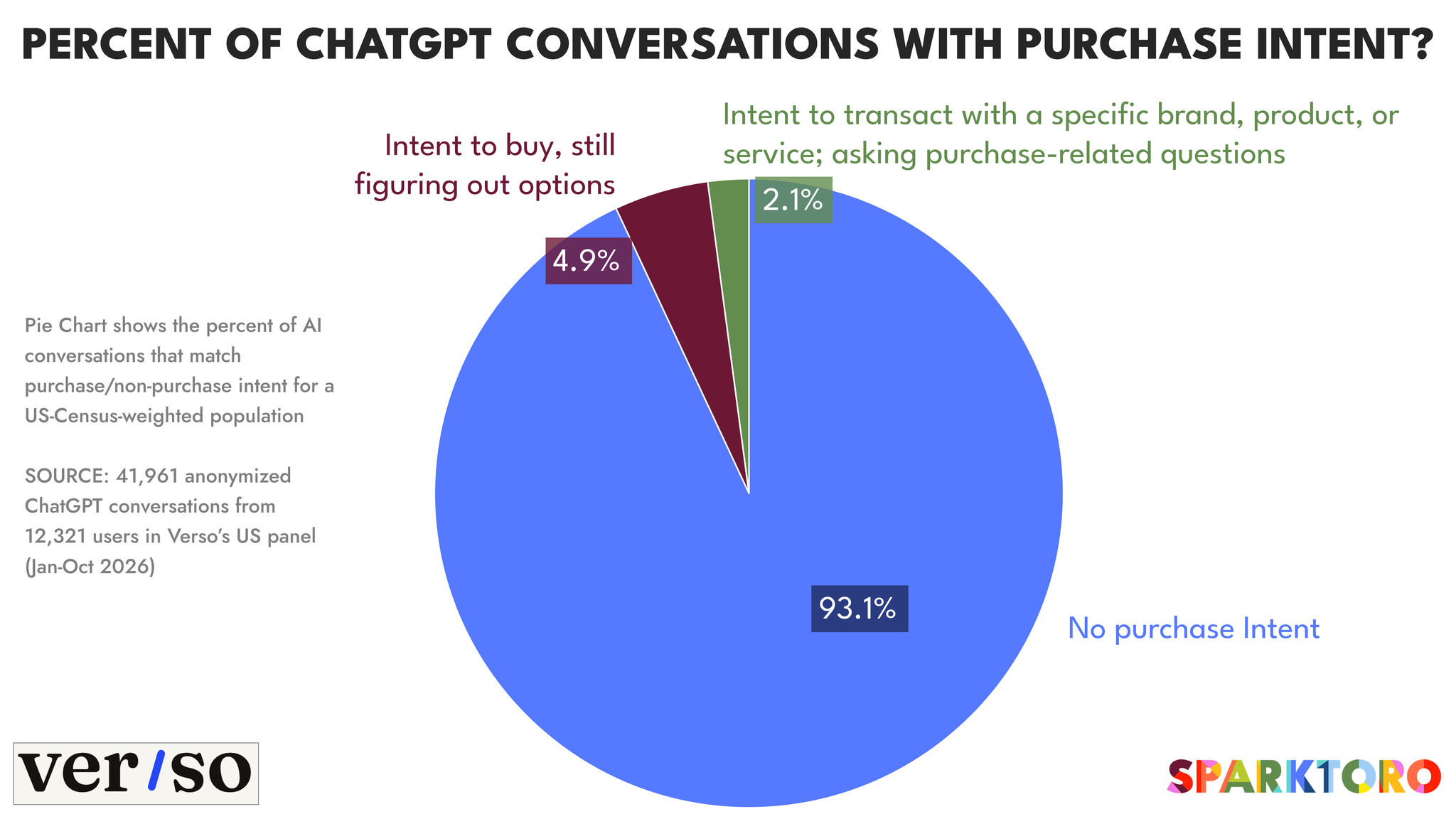
Fishkin wrote, “I suspect this is bad news for ChatGPT’s advertising opportunities.”
He also referenced SparkToro’s December 2024 analysis of approximately 332 million Google searches. He wrote that 15% or more of searches fit his definition. SparkToro did an analysis of searches done by a U.S. panel via browsers from January 2023 through September 2024. Commercial (a financial, business services or commerce intent) accounted for 14.5% of searches, although the searcher may not have been ready to make a purchase at that time.
Transactional accounted for 0.69%. These categories do not match the categories identified in the ChatGPT graph which measured purchase intentions, so the percentages cannot be compared directly.
How Often Brands Came Up
In addition to tracking whether people asked about brands, the report also tracked if ChatGPT’s responses named any. In the weighted group, 86.7% of all prompts did not ask for brand, product or company information. Of all prompts, 6.6% asked about several brands, with the remainder being about a single brand (6.7%). On the response side, 7.0% of all responses mentioned multiple brands, products or companies while 5.1% mentioned one; the post’s reported percentage of responses mentioning at least one was 12.1%.
The post’s takeaways describe 12% of ChatGPT usage as part of the buyer journey, though its purchase-intent chart puts conversations with purchase intent at 6.9%.
What People Used ChatGPT For
Images and visual design requests were the top ranked category in the report with a total of 17.6% of conversations. Information and entertainment came second in terms of overall conversations (14.4%), writing and communication third (12.7%), while shopping, brands and local services made up 5.3%.
One category per conversation was assigned, representing the primary goal of each. The output type counts over the topic when someone asks ChatGPT to create something (e.g., if you ask it to write an email asking for a refund from PayPal, that would be categorized as writing instead of shopping).
The percentages shown in the report’s chart vary from the percentages shown in the report’s text by less than two percentage points per category. The percentages provided here reflect the report’s chart.
How The Panel Compares With OpenAI’s Data
The panel was also compared to OpenAI’s Signals data for September using the weighted group. OpenAI’s data was heavier towards writing and tech support, while the weighted panel data leaned more toward image requests and how-to questions. The author says the two are fair to compare given that OpenAI almost certainly includes API requests (that Verso does not track) in its numbers.
According to OpenAI’s page, the dataset “reflects only messages within ChatGPT Free, Go, Plus, and Pro accounts” and Codex and enterprise usage are excluded from this count; thus excluding API calls as well. In addition, OpenAI presents global message shares whereas the panel shows shares of U.S.-based conversations.
About The Data
Verso offers a free tool that breaks down a person’s ChatGPT history. Its sign-up terms say Verso stores the imported conversations and includes them, de-identified, in datasets it licenses to research and business customers. According to the post, Verso co-founder Aaron Aknin reached out to the post’s author and supplied the data.
The report also described the panel as skewed toward younger people, women and people at lower income levels. There were 9,675 members in the panel that had demographic information that could be used as a weighting base to match the 2024 United States Census. No usage category varied by more than 1.4 percentage points when the demographics were weighted to these standards.
Before the data analysis was performed, the 131 heaviest users, who generated an average of over 33 prompts per active month, were eliminated. These heavy users accounted for approximately 1% of the total number of panelists, but they were responsible for sending 21% of all prompts. On average each member of the weighted group (excluding the above noted heaviest users) sent 9.9 prompts between January and October.
As most panelists were recorded on mobile phones, the post says this may have caused some of the usage through desktop computers and work accounts to be underreported. API requests are not included in the data set.
Each conversation was coded using a written code book provided to Anthropic’s model called Claude. Each conversation was coded based upon its title, up to six of the user-generated prompts, the initial few lines of ChatGPT’s first few responses and any product cards or bolded names. A second coder independently recoded a random sample of conversations, and the two coders agreed on categories 90% of the time and on brand tags 97% to 99% of the time. The post reports no separate agreement figure regarding its identification of purchase intent.
SparkToro sells audience research software.
Why This Matters
For brands splitting AI visibility and ad budgets, the U.S. panel gives a measured share of ChatGPT conversations that involve buying, and it’s under 7%. Fishkin concludes that Google’s AI Overviews and AI Mode are what make AI visibility important, and he questions whether tracking ChatGPT visibility is worth it unless Bing rankings and AI visibility are tracked too.
The post explains that the panel reflects what people ask ChatGPT much better than how often they use it. For PPC teams exploring ChatGPT Ads, the 6.9% purchase-intent share offers a snapshot of the conversation mix in a consumer panel with light ChatGPT use, not a count of purchase-related conversations across ChatGPT.
Looking Ahead
Until panel data includes desktop, work and API use, it’s best to pair purchase-intent figures like this one with your own ChatGPT referral and ad data before adding them to a budget plan. Fishkin also shared that he looks forward to doing more research with Verso.
Featured Image: arda savasciogullari/Shutterstock
