
United Airlines’ website terms, updated Nov. 11, allow search engines to index its public pages. However, any AI agent that searches, books, or makes purchases on united.com or in its app needs written permission. The terms also bar anyone from using fares, schedules, availability, pricing or other data from United’s site or app to “train, fine-tune, ground, evaluate, or otherwise develop” an AI model.
The changes came with United’s announcement that it is restricting unauthorized third-party AI agents on its own platforms and through travel agencies and booking sites. The airline updated its contract of carriage (the passenger agreement that comes with buying a ticket) on the same day.
For those on SEO and ecommerce teams who have created their own rules for AI agents, the airline’s rules are an example of what a big company has done. The rules for the AI agents can be found in both the terms and conditions and the contract. As of Nov. 14, United’s robots.txt file named no crawlers or agents for any AI.
What United Announced
The announcement from United says that sharing account login credentials with an outside third-party AI assistant can expose customers’ sensitive information. Furthermore, according to the announcement, there are potential risks of “unintended purchases, account changes, or use of MileagePlus miles.” In addition to these risks, automated actions by the AI assistant may violate Federal Aviation Administration (FAA) and Department of Transportation (DOT) regulations. United points to check-in as an example, saying it requires a person to acknowledge that their bags hold no banned items like explosives.
United’s FAQ on its Digital Trust Center calls any AI agent, bot, browser extension or browser feature unauthorized if it searches, books, buys, manages or collects information on united.com or the United app without United’s permission. Using AI to research and plan a trip is allowed as long as the tool doesn’t access united.com or the app.
United doesn’t work with any third-party AI agents yet, according to the FAQ, and bookings that agents made before Nov. 11 won’t be canceled.
In The Wall Street Journal’s report, CEO Scott Kirby said at an event in Chicago, “I don’t want to create another middleman.”
What United’s Website Terms Allow And Bar
United’s terms of service define an Automated Agent as any software, service or feature that, with full or partial autonomy, searches, books, buys or manages items on the United website or app, or extracts or copies data from those websites or apps. This includes AI assistants, bots, scrapers, browser extensions and features built into browsers or apps, even if a person supervises or approves the actions of the Automated Agent.
No Automated Agent shall be permitted to access United’s site or app without prior written permission from United, and United reserves the right to block or impede an Automated Agent at any time, regardless of who operates it (the user, a third party or an artificial intelligence company).
One of the uses United’s terms of service bar for data pulled from its site or app is grounding, which involves an AI system pulling in outside content to build a response.
Search engines that index the public pages of united.com are exempt under the terms of service. The terms of service also exempt assistive technology and standard browsers used by a person. However, built-in agent features of a browser are not exempt. Additionally, the terms of service do not address how they treat answers created by AI systems from search engines’ indexes.
Use of an Automated Agent on United’s site results in acceptance of the agreement by the user, whoever runs the agent and the person for whom the agent acts. In September, Amazon blocked Meta’s Muse agent based on its Conditions of Use, which bind the shopper rather than Meta, as Slobodan Manic reported for SEJ. eBay has added “buy-for-me agents, LLM-driven bots” to its User Agreement‘s list of automated tools that need eBay’s permission, in an update it posted in January.
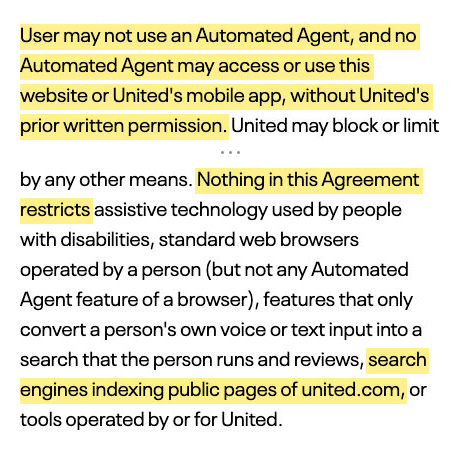
The highlighted excerpts below show United’s permission requirement and its search-indexing exception.
The Contract Reaches Travel Agencies
The contract of carriage uses its own term “AI Agent” to describe all computer-based applications (software) utilized on behalf of a traveler or other individuals, to locate, research, book, purchase or otherwise manage any offer from or through United, regardless of whether an individual is monitoring or approving such activity. Examples include assistant capabilities built into social media, messaging or search platforms, browsers utilizing AI capabilities, stand-alone AI-enabled agents, and third-party AI assistants connected to United via some type of interface provided by a travel agency or other intermediary.
Rule 6.J.6 adds using AI agents to “make, modify or service a Ticket,” or to buy any service or product, to the contract’s prohibited practices, next to hidden-city and throwaway ticketing. Rule 5.H lists bookings that AI agents made, changed or serviced among the improper bookings United will cancel without notice.
According to the FAQ, travel agencies and booking platforms aren’t permitted to use third-party AI agents to search for, book, or manage United travel on behalf of customers. Agencies also need to get United’s permission before using their own third-party AI tools.
Why This Matters
United’s terms separate search indexing from AI agent access, and none of it depends on robots.txt. Personal agents like Muse publish no user agent for a robots.txt rule to name, as Manic wrote in October. Reviewing your robots.txt, terms, and bot protection together can help you see whether they’re aligned on what an AI agent is allowed to do on your site.
Looking Ahead
United says it will keep reviewing how AI assistants work with its services and will update its FAQ if it starts working with third-party agents. United’s release, FAQ, terms and contract don’t say how it detects an agent, so watch how the rules are enforced for travel agencies and agent makers, and whether other airlines write similar rules.
Featured Image: Funstock/Shutterstock
