

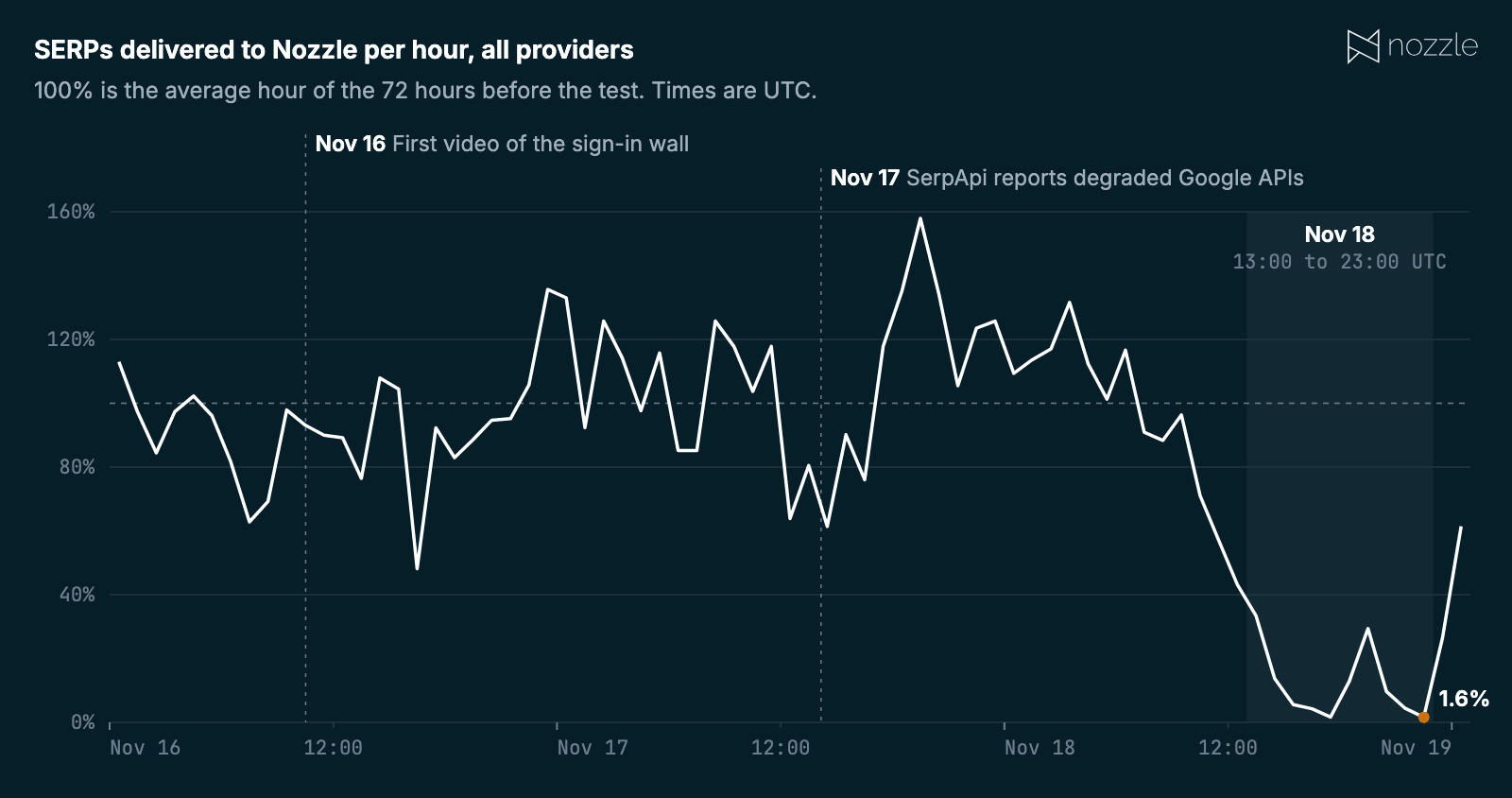
Google search results that reached rank tracker Nozzle dropped to about one-tenth of their usual volume for approximately 10 hours on Nov. 18 based on information from Nozzle. Also during this time frame, Google was still rolling out its November core update.
Some of the blocked searches ended up on a Google page asking users to sign in prior to seeing search engine results. On Nov. 17, Rajan Patel, the VP of Engineering for Search at Google, commented that he did not believe this login page was supposed to appear on the first page of search results, though Google could be conducting a test.
The numbers reported by Nozzle are based on its own collection through the five SERP data providers which processed the requests made by Nozzle that day. So Nozzle’s reports cannot provide evidence of whether other rank tracker companies experienced the same drop in deliveries. Nozzle is a company that sells tools for tracking rankings.
How Nozzle’s Collection Fell
Deliveries to Nozzle fell at all five providers for several hours, as Derek Perkins wrote in an article dated Nov. 18 on the Nozzle blog. Nozzle was collecting normally on Nov. 17 and until late morning UTC on Nov. 18, when deliveries slowed down.
On Nov. 18, from 8 a.m. to 6 p.m. ET, Nozzle received 11.6% of what would be collected during 10 regular hours. During each provider’s worst hour, that provider received 2% or less of its regular hourly amount.
Nozzle’s hourly chart shows when the drop began and when deliveries started to recover.
One of the providers also told Nozzle that there had been an increase in CAPTCHAs on its iPhone searches, going up from approximately 19% of total requests to approximately 90%. Thirty-one percent of a sample of blocked attempts from that provider ended up on Google’s sign-in page and the remainder on a CAPTCHA. Searches made from desktop computers were hardly affected, Nozzle says.
Google’s Sign-In Page
The sign-in page shows “Sign in to continue” with the line “Sign in to verify you’re a human and see more results.” The sign-in button does not link to the search results, according to Nozzle.
Here’s what the prompt looked like in Clark’s incognito window.
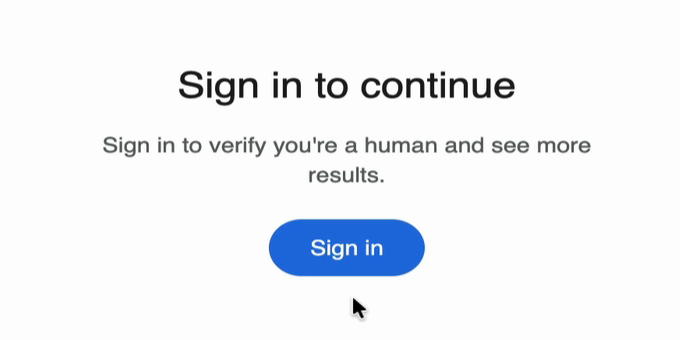
On Nov. 16, Brodie Clark, who runs SERPalerts, posted a video from an incognito window showing that prior to seeing any results, the user had to enter their credentials.
The following day, Patel responded to Clark’s post.
Looking into this. I don’t believe it’s meant to happen on the first page of results like this but we may be testing something here…
Nozzle’s requests also encountered CAPTCHAs and a delay page. From Perkins’s perspective, a CAPTCHA can be solved and the delay waited out, but neither option works on the sign-in wall.
The wall adds to the goto link limits I covered on Nov. 5, which cap how fast tools can follow the result links on one Google results page.
Why This Matters
The time period of Nozzle’s 10-hour fall in collection coincided with the time frame during which Google’s November core update, which started Nov. 10, was still being rolled out. According to Google’s dashboard, the rollout “may take up to 2 weeks to complete” and there were no entries indicating completion when I reviewed the page on Nov. 22.
Prior to reporting a Nov. 18 ranking drop as part of the core update, first verify whether your rank tracker pulled regular Google search results that day, beginning with mobile. When a drop coincides with a core update, follow Google’s instructions by using Search Console, waiting at least one full week beyond the time when the rollout is finished and then trying a comparison of that week with the week prior to its start.
Looking Ahead
Google’s dashboard will show the end date once the core update is complete.
The sign-in page didn’t go away when Nozzle’s drop ended. It still appeared on a little under 1% of page loads at the provider that reported the iPhone CAPTCHAs, according to Nozzle’s Derek Perkins.
Featured Image: Esin Deniz/Shutterstock
