

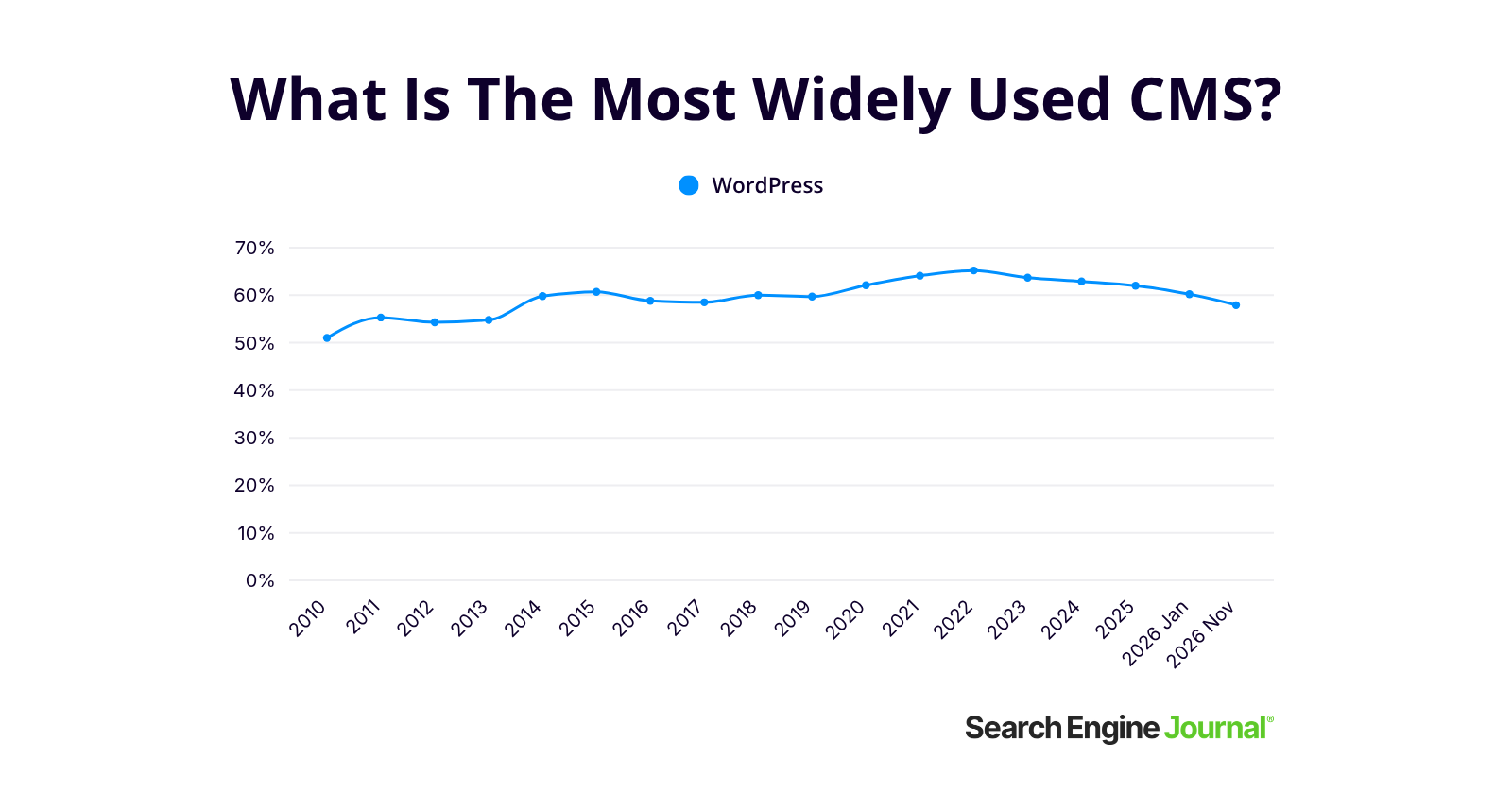
WordPress might remain the dominant force in content management systems (CMS) for now, but market share has dropped since its peak in 2022 to under 60%. According to W3Techs on Nov. 13, 2026, WordPress now has a CMS market share of 57.9%. Looking at historical data, WordPress dipped under 60% in 2016, 2017, and 2019, but this is the lowest drop since 2013.
WordPress still remains a substantial lead over its nearest rival, Shopify, but is this an indication of a downturn for WordPress, or for the general usage of CMS?
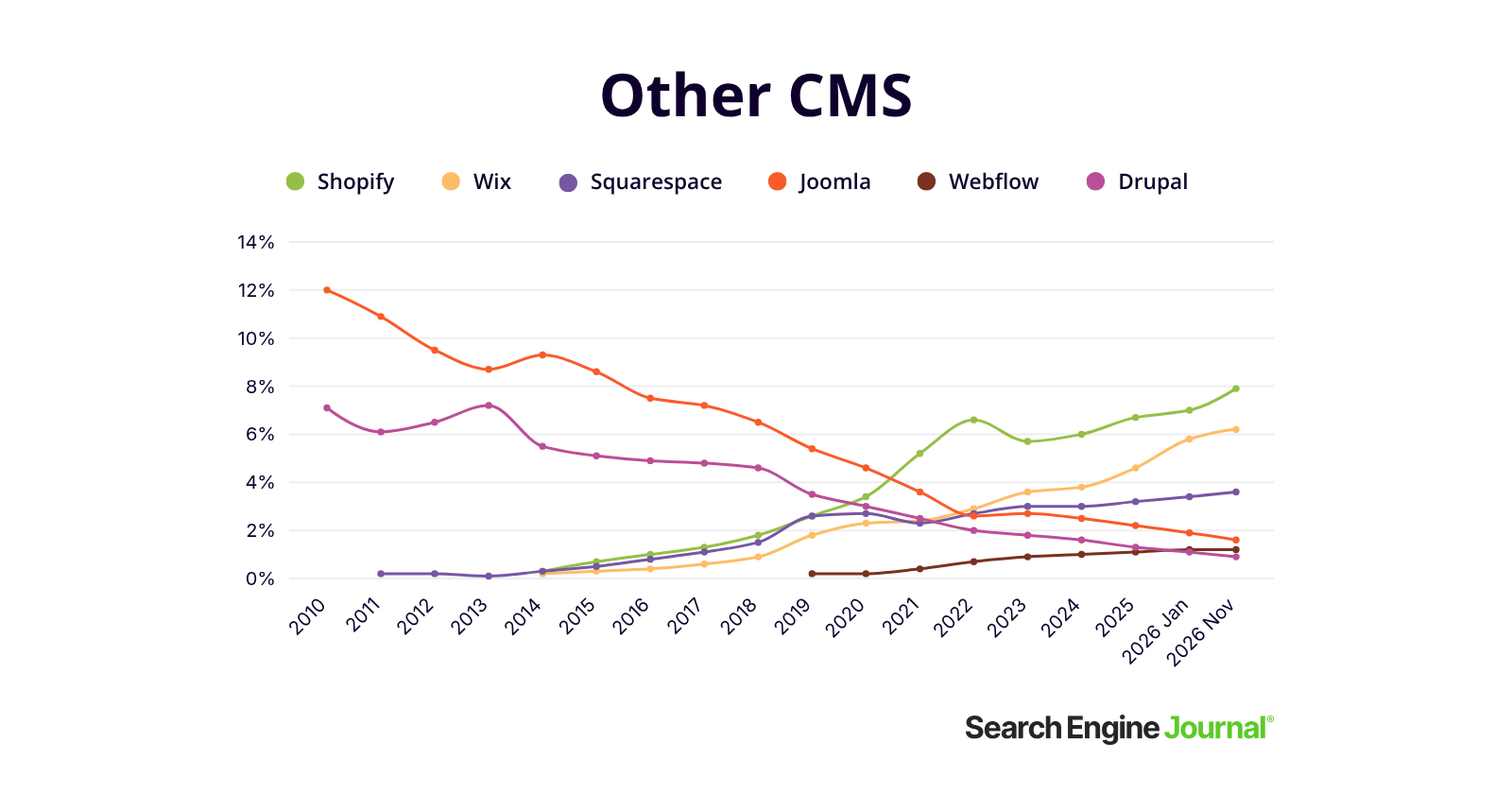
Shopify has continued its growth across all surveyed websites, with Wix and Squarespace also maintaining their growth trajectory. In fact, apart from Joomla and Drupal, which fell, and Webflow, which held flat, all other top CMS have increased market share, indicating WordPress is on a downturn to the benefit of other platforms.
This report breaks down the current CMS landscape, compares the top platforms, and outlines the latest shifts in market share and usage.
How Large Is The CMS Market?
According to W3Techs, 67.7% of websites have a CMS, and Netcraft reports over 323 million domains
From this, we can assume that the current market size for content management systems has risen to 218.8 million websites.
| Platform | Usage (all sites) | Estimated sites* |
|---|---|---|
| All monitored CMS | 67.7% | 218.8 million |
| WordPress | 39.2% | 126.7 million |
| Shopify | 5.4% | 17.4 million |
| Wix | 4.2% | 13.6 million |
| Squarespace | 2.4% | 7.8 million |
*Approximations extrapolated from W3Techs and Netcraft data
Top 10 CMS By Market Share (Globally), November 2026
There are two different measures throughout this report: usage is a platform’s percentage of all surveyed websites, while market share is its percentage of websites with a known CMS.
| Rank | CMS (November 13, 2026) | Type | Market Share | Usage |
|---|---|---|---|---|
| – | No detected CMS | – | – | 32.3% |
| 1 | WordPress | Open source | 57.9% | 39.2% |
| 2 | Shopify | SaaS | 7.9% | 5.4% |
| 3 | Wix | SaaS | 6.2% | 4.2% |
| 4 | Squarespace | SaaS | 3.6% | 2.4% |
| 5 | Joomla | Open source | 1.6% | 1.1% |
| 6 | Tilda | SaaS | 1.2% | 0.8% |
| 7 | Webflow | SaaS | 1.2% | 0.8% |
| 8 | Duda | SaaS | 1.1% | 0.7% |
| 9 | GoDaddy Website Builder | SaaS | 0.9% | 0.6% |
| 10 | Drupal | Open source | 0.9% | 0.6% |
Data from W3Techs, Nov. 13, 2026. (WooCommerce and Elementor are not listed in the table above as they’re WordPress plugins and not standalone CMS platforms.)
*Graphs are separated due to the dominance of the WordPress market share.
WordPress
WordPress remains the most widely used CMS. Its usage across all surveyed websites rose from 23.3% in January 2015 to 43.2% in January 2022, before falling to 39.2% today.
But its long-standing growth curve is now in a downturn. Its CMS market share has fallen by approximately 7.3 percentage points from the January 2022 figure of 65.2%. Since Jan. 1, 2026, it has declined from 60.2% to 57.9%, while all-website usage has dropped from 43.0% to 39.2%.
Those figures do not show why individual sites changed platforms. For teams using WordPress, plugin compatibility, core updates, and security management remain practical considerations.
Read more: Should You Still Use WordPress?
Shopify
As the second-most popular standalone CMS in W3Techs’ current listing, Shopify’s market share stands at 7.9%, and it is used by 5.4% of all websites surveyed. Both measures have increased from Jan. 1, 2026, when they stood at 7.0% and 5.0%, respectively.
Market share is not a performance benchmark. For a separate, historical comparison of technical performance, see our 2025 Core Web Vitals CMS rankings.
From an SEO and business perspective, Shopify’s growing footprint makes it a platform worth evaluating alongside the features, costs, and technical requirements of an online store.
Wix
Wix now powers 4.2% of websites surveyed and holds 6.2% of the known-CMS market. Its market share has increased from 5.8% at the start of 2026, but its all-website usage remains at 4.2% at the displayed precision.
Wix has benefited from its positioning beyond a lightweight website builder that consistently invests in branding and platform capabilities, making it a viable contender for mid-market adoption.
Squarespace
Squarespace’s CMS market share has grown from 0.5% in January 2015 to 3.6% today, with 2.4% of all websites surveyed now using the platform.
Its growth could be attributed to the increasing demand for low-maintenance, design-forward platforms that are easily accessible to small businesses and individuals.
Read more: WordPress Vs. Squarespace – Which One Is Better?
Joomla, Webflow, And Drupal
In contrast to all the other top CMS surveyed, Joomla and Drupal have continued to lose CMS market share, now accounting for 1.6% and 0.9%, respectively. At the start of 2026, those figures were 1.9% and 1.1%.
Once platforms in favor with web developers and amateur coders, this shift likely reflects a broader trend where more user-friendly, SaaS-based platforms capture the attention of small businesses and non-technical users.
Webflow, which last year looked like a growing contender, now holds at 1.2% of the known-CMS market, unchanged from Jan. 1, 2026. Its usage across all surveyed websites has slipped from 0.9% to 0.8%.
No CMS
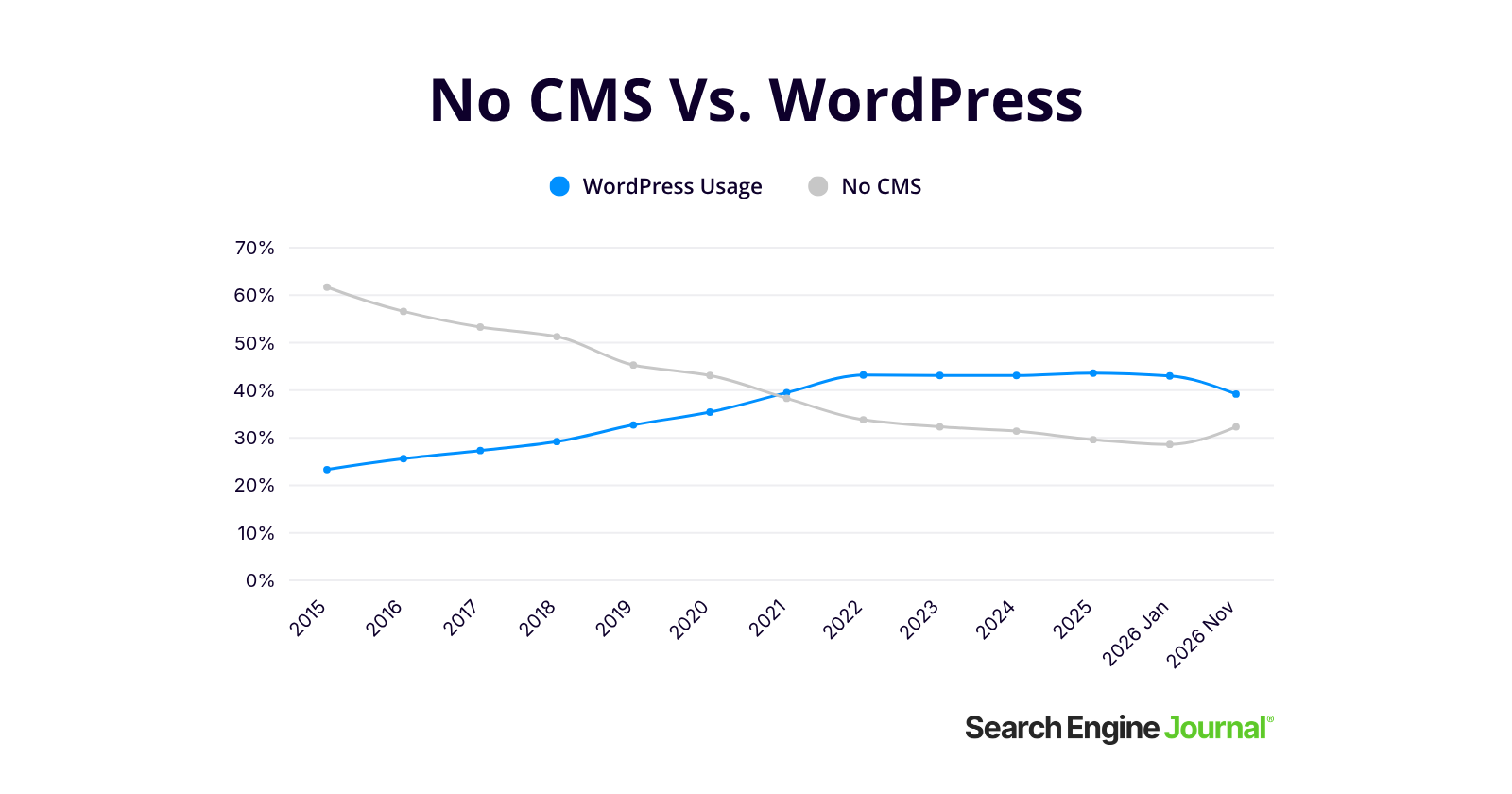
Between Jan. 1 and Nov. 13, 2026, the proportion of websites using none of W3Techs’ monitored CMS platforms rose from 28.6% to 32.3%, an increase of approximately 3.7 percentage points. During the same period, WordPress usage fell from 43.0% to 39.2% of all surveyed websites.
That reverses the earlier downward trend in the “no CMS” category. It is not proof that those sites are custom-coded or have abandoned a CMS, as the category means that no monitored CMS was detected.
WordPress Vs. Joomla Vs. Drupal Market Share
Since January 2024, Joomla’s CMS market share has fallen from 2.5% to 1.6%, while Drupal’s has declined from 1.6% to 0.9%. Over the longer period, Joomla has dropped from 8.6% in January 2015 and Drupal from 5.1% in the same month.
They’ve slipped from the No. 2 and No. 3 spots to No. 5 and No. 10, overtaken by faster-growing platforms like Wix and Squarespace in 2022.
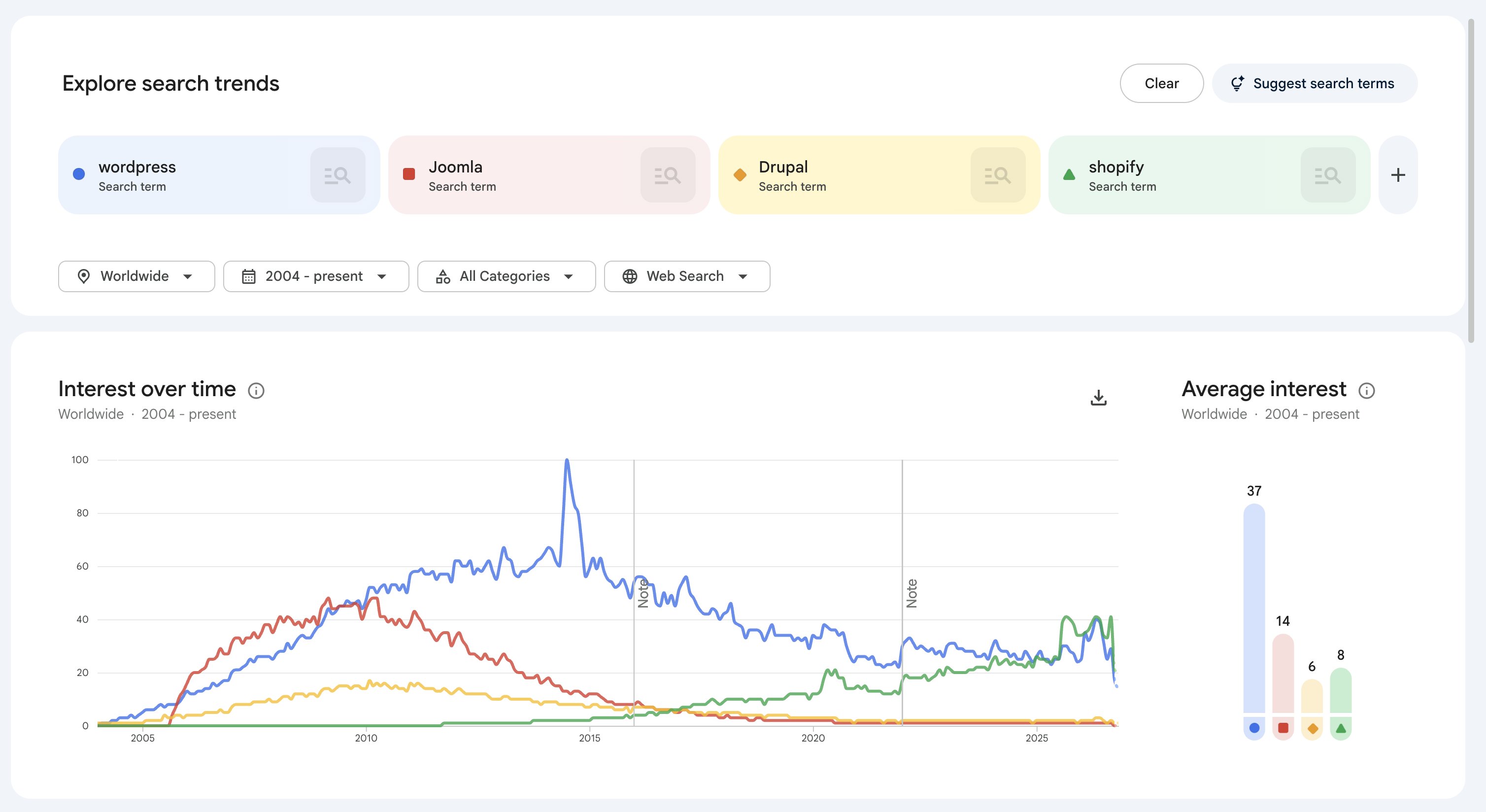
Joomla, in particular, had strong momentum early on – briefly surpassed WordPress in search interest until around 2008, according to Google Trends – but it hasn’t kept pace with modern platform demands.
Shopify is the platform with the most interest overtaking WordPress.
Why did these popular content management systems decline so much?
It’s most likely due to the strength of third-party support for WordPress with plugins and themes, making it much more accessible. But the rise of supported themes and plugins for Shopify is starting to gain on WordPress.
The growth of website builders, such as Wix and Squarespace, indicates that small businesses want a more straightforward managed solution, and they have started to nibble on market share from the bottom. Although, it does not establish that users moved directly from Joomla or Drupal to those platforms.
Website Builders Market Share: Wix Vs. Squarespace
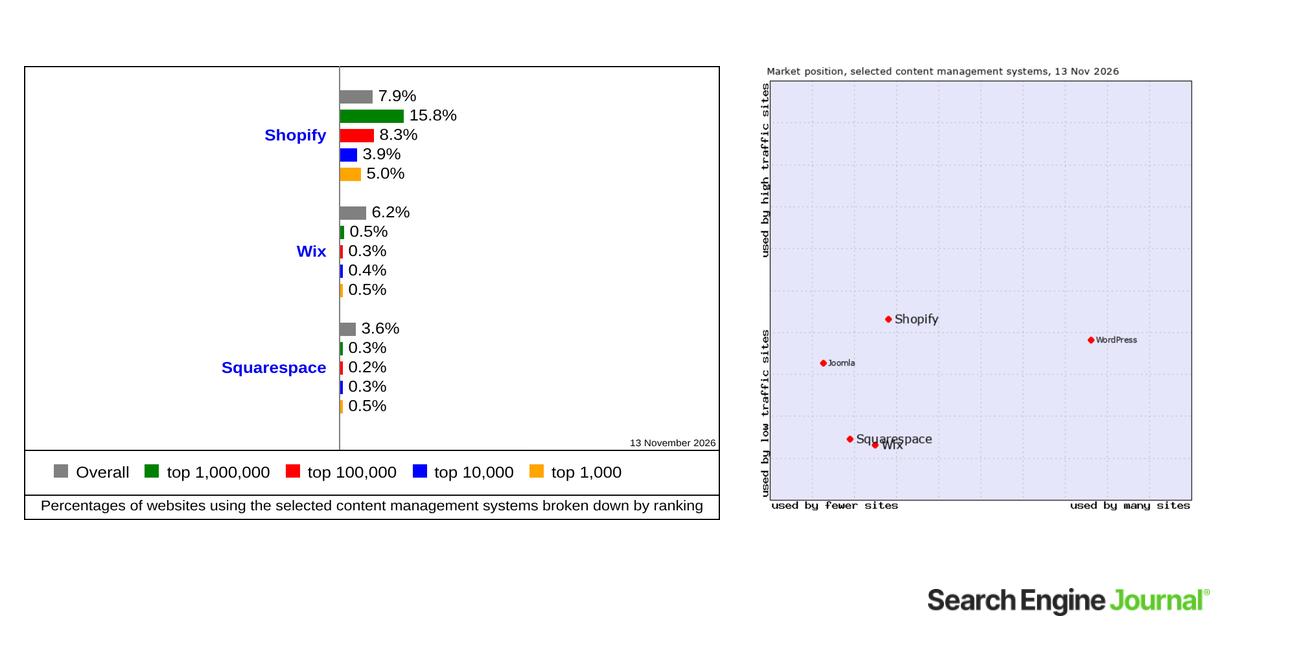
Over the period from November 2025 to November 2026, the CMS market share of:
- Shopify rose from 6.8% to 7.9%, a gain of 1.1 percentage points, or 16.2% growth.
- Wix rose from 5.7% to 6.2%, a gain of 0.5 points, or 8.8% growth.
- Squarespace rose from 3.4% to 3.6%, a gain of 0.2 points, or 5.9% growth.
Growth has slowed sharply for Wix and Squarespace, while Shopify’s has accelerated from 4.6% to 16.2% and taken the lead against the others in a reversal from the last reported period (Wix was growing by 32.6%, Squarespace 9.7%, and Shopify by 4.6%).
As mentioned above, SaaS web builders don’t require coding knowledge and offer an opportunity for a small business to get a web presence quickly. The rise of Shopify could be attributed to an influx to the platform from WooCommerce, as the WordPress alternative.
WordPress is not known as a complicated platform to use, but it does require some coding knowledge and an understanding of how websites are built. On the other hand, a website builder is a much easier route to market, without the need to understand what is happening in the back end.
Elementor
Elementor is the most widely used WordPress page builder, installed on 18.2% of all websites with a known CMS and 12.3% of all sites surveyed (not shown below) – more than Wix and Squarespace combined – though it functions as a plugin within WordPress, not a standalone CMS.
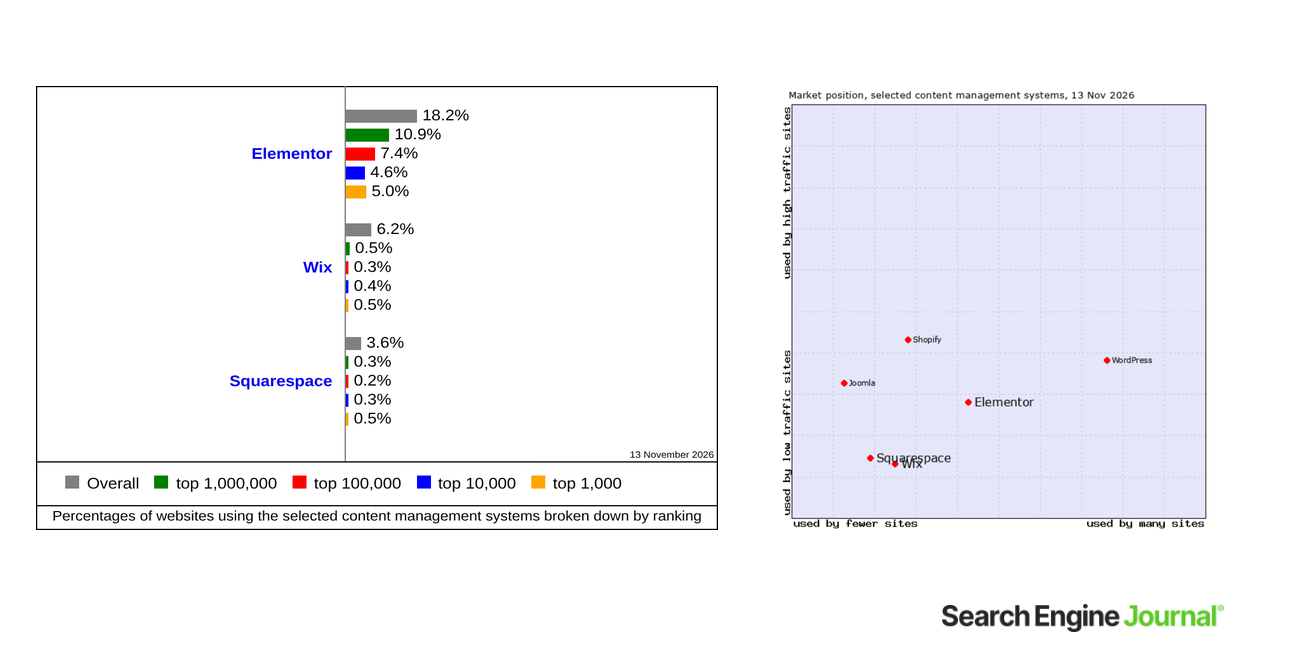
While not a CMS on its own, it is a major part of the WordPress ecosystem. Its figures overlap with WordPress and should not be added to WordPress’s market share or usage.
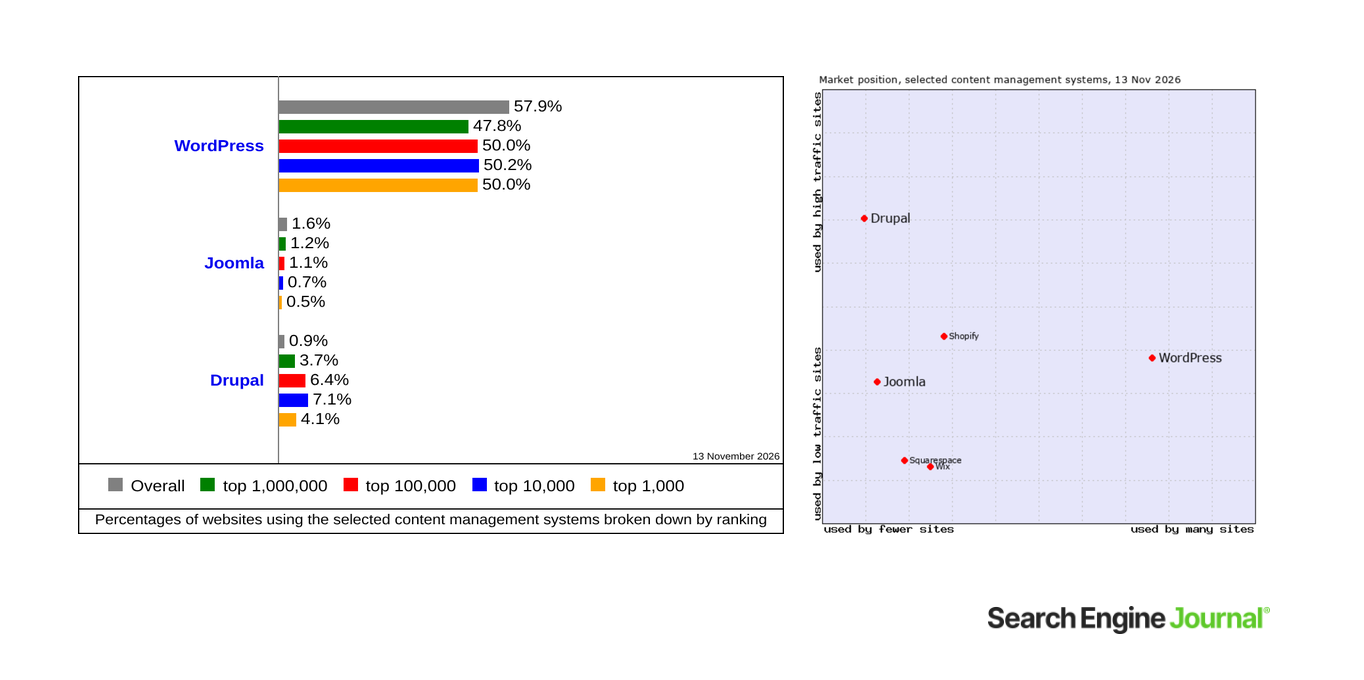
W3Techs also compares platforms by overall popularity and traffic rank. The ranking bars measure a platform’s share among sites with a known CMS within each ranking tier, rather than its share of all websites.
The WordPress, Joomla, and Drupal comparison above shows Drupal with a smaller overall footprint but a stronger presence among highly ranked sites. WordPress remains much more widely used overall.
Wix and Squarespace have lower representation in the top-ranked groups than in the overall known-CMS sample. That is a traffic-ranking distinction, not a direct measure of business size or the quality of the software.
Elementor gives site owners a visual way to build within WordPress. For businesses comparing drag-and-drop tools, the practical question remains how the builder fits their design, maintenance, and SEO requirements.
Ecommerce CMS Market Share: WooCommerce Vs. Shopify
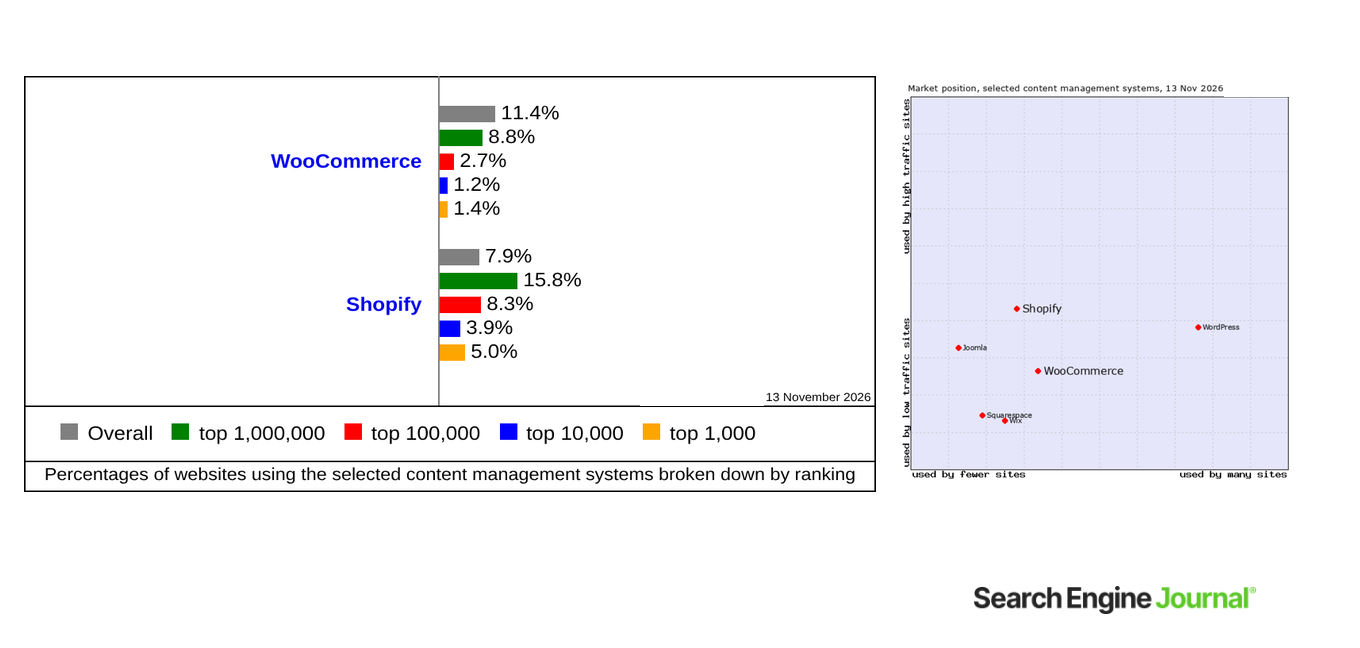
WooCommerce has seen a decline to 11.4% of websites with a known CMS, while Shopify has increased to 7.9%.
WooCommerce powers 7.7% of all websites surveyed, compared with Shopify’s 5.4%. As a WordPress-based ecommerce platform, it is included within the WordPress ecosystem rather than listed as a separate standalone CMS in the top 10 above.
W3Techs’ separate ecommerce-system survey uses a different denominator: websites using an ecommerce system that W3Techs monitors. On that measure, WooCommerce has a 47.0% share and Shopify 32.7%. Those figures do not measure sales, revenue, or every online store worldwide.
In comparison to other ecommerce CMS platforms, WooCommerce is still dominant right now.
It has more market share than its competitors combined: Shopify (7.9%) + PrestaShop (0.7%) + OpenCart (0.4%). But it is losing ground, and this could be correlated to the decline of WordPress and users moving to other platforms. It will be interesting to see if Shopify overtakes in the next year.
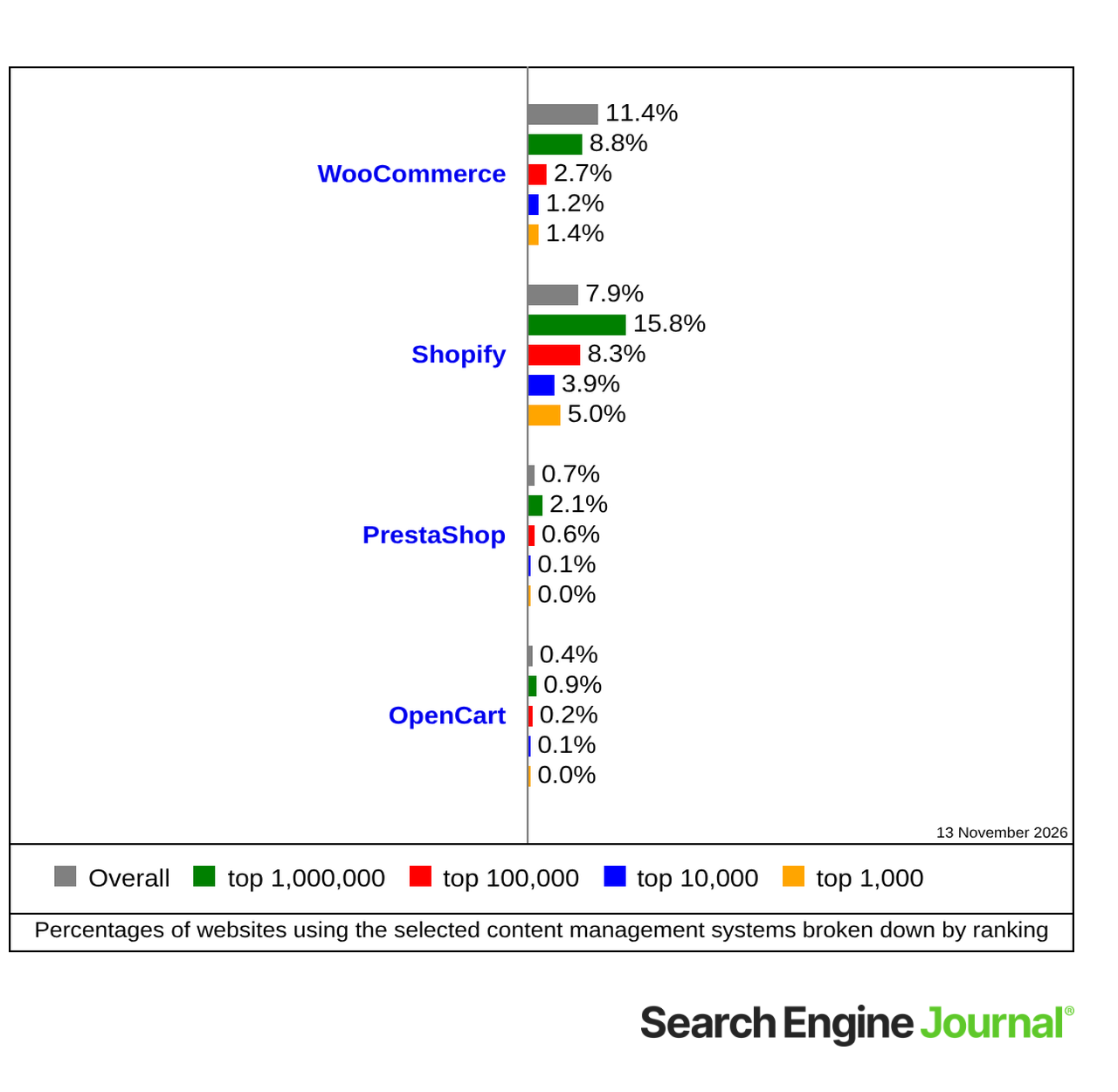
The ranking comparison also shows why overall adoption is only part of the picture. Shopify has a stronger presence than WooCommerce in several of the higher-ranked groups, even though WooCommerce has the larger overall share of the known-CMS sample.
Shopify surged during the pandemic, with market share growing by 52.9% from 2020 to 2021 and then 26.9% from 2021 to 2022, outpacing every other platform. After a dip in 2023, it recovered in 2024 and has reached 7.9% market share this year.
Why Does CMS Market Share Matter For SEO And Business Strategy?
As the market changes, platform choice affects site architecture, plugin availability, and technical SEO flexibility.
WordPress continues to lead, but its gradual decline marks a turning point. SaaS competitors such as Shopify, Wix, and Squarespace are steadily gaining traction, offering streamlined platforms that appeal to most businesses.
If more SMBs are switching to website builders, understanding the limitations and intricacies of these platforms for SEO could be a competitive advantage. CMS adoption determines how efficiently teams can build, secure, and optimize sites at scale.
The one area I am most interested in is how AI and vibecoding might impact CMS platforms and if there will be a rise in websites without a CMS.
Shopify now runs on 5.4% of all websites surveyed, not just sites with a CMS. With its increasing footprint, specializing in Shopify SEO could be a strategic move for an SEO professional.
Wix and Squarespace remain important alternatives, too. Getting fluent in their ecosystems could help you serve businesses with different development and maintenance requirements.
The reality is that WordPress remains the largest ecosystem in this survey, while other platforms give business leaders and SEO professionals an opportunity to diversify their expertise.
Understanding the strengths and limitations of various CMS platforms can inform strategic decisions and align with evolving market demands.
More Resources:
- WordPress SEO Myths Busted: What You Really Need To Know
- Essential WordPress Plugins Every Site Should Have
- How To Improve Speed And Performance For A WordPress Site
CMS usage and market-share data collected from W3Techs on Nov. 13, 2026. Historical comparisons use the dates stated in the text. Percentages are rounded by the source, so calculated changes are approximate. See the W3Techs methodology page for how the survey is compiled. Google Trends measures search interest separately.
Featured Image: Paulo Bobita/Search Engine Journal
