
On Nov. 18, Salesforce CEO Marc Benioff said “Goodbye SEO” on X, promoting Palmata, an AI-based tool for tracking how visible a company is in AI answers, while a Salesforce guide linked on Palmata’s page states SEO “is still the foundation.”
Benioff wrote in his post that customers “aren’t searching anymore” but instead are asking Claude, ChatGPT, Gemini and other AI assistants which brands they should purchase. The post further states, “No click. No referral. Nothing in your analytics,” and then pitches Palmata as a tool that monitors what AI assistants say about a business, offers recommendations on what changes need to be made, and simulates the effect of those changes prior to publication.
Several SEO professionals countered Benioff’s claims in quote posts and replies.
What Salesforce’s Pages Say
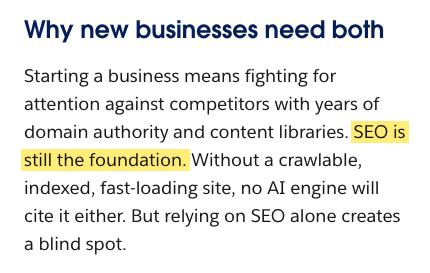
Salesforce’s guide to SEO and AEO (answer engine optimization) says SEO “isn’t going away” and that “SEO is still the foundation.” Graham Hardt, whose byline lists him as SEO Senior Director, wrote it for new businesses, and Salesforce published it Sept. 11. Palmata’s product page links to the guide from its FAQ.
Contentful introduced Palmata in June; it became a part of Salesforce when Salesforce’s acquisition of Contentful occurred on Sept. 1. The article announcing the launch of Palmata, written by Jason McGhee, head of product and engineering for Palmata, said that SEO gave organizations “a practical framework for improving visibility” and added, “That work remains essential.”
How SEO Professionals Responded
Aleyda Solis, an SEO and AI search consultant who founded Orainti, wrote in a quote post that AI search “relies on many of the same fundamentals as SEO.” Her post continues, “AI search optimization goes beyond traditional SEO, but it certainly doesn’t replace it.”
Solis also wrote that measuring AI search visibility matters, “but monitoring what AI platforms say about your brand and actually improving your visibility, recommendations and business outcomes are very different things.”
Pedro Dias, a technical SEO product manager who used to work at Google, wrote that SEO “was never a topic that attracted the interest of decision makers.” His post adds, “SEO isn’t traffic. It never has been.”
Lily Ray, who founded Algorythmic, replied to Benioff, “This gold rush already happened and the market is already oversaturated.” Growth advisor Eli Schwartz wrote that “there’s yet another AEO tool in the mix.”
Why This Matters
When Benioff’s post is read by a marketing executive, Salesforce’s own guide answers it, stating that SEO and AEO are “two visibility layers for the same audience.”
In terms of making the case for new businesses to include both SEO and AEO, this guide provides Salesforce’s reasoning for including SEO in your plans right alongside any AI visibility tool, such as Palmata.
Looking Ahead
According to Palmata’s FAQ section, Palmata is a standalone tool that is also built into Marketing Cloud by Salesforce. In weighing tools like Palmata, Salesforce’s guide says you should track “both sets of metrics.” This means tracking your organic traffic and rankings, but also tracking how many times you’ve been cited by AI.
Featured Image: Thrive Studios ID/Shutterstock
