

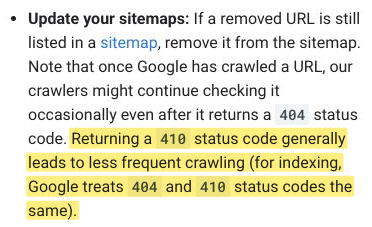
Returning a 410 status code for a removed page “generally leads to less frequent crawling,” according to Google’s updated guide to crawling errors. For indexing, Google treats 404 and 410 the same.
The line arrived on Nov. 27 in a new section on deciding whether to fix 404 errors reported in Search Console. The documentation changelog says the section brings 404 guidance over from the Search Console Help Center into Search Central documentation, and the old Help page now redirects to the guide.
Most of the section revisits advice Google had already shared, but its 410 line offers a different take from the Help page. The retired page read, “Currently Google treats 410s (Gone) the same as 404s (Not found).”
410s And Crawl Frequency
Google’s new guidelines have separated crawling of pages with 404 or 410 status codes from how they are indexed by Google. For a URL that was crawled by Google but returned a 404 status code, Google’s crawlers “might continue checking it occasionally,” the guide says. The frequency of crawling is generally reduced once Google receives a 410 status code, and a 410 is treated like a 404 when it comes to indexing.
When I covered John Mueller’s comments on the two codes in April 2024, he called the difference in processing “so minimal” that he couldn’t think of a time he’d prefer one over the other for SEO purposes. The new guide keeps the codes equal for indexing and names a difference in crawling.
Google’s guide puts the crawl-frequency distinction in its advice on removing URLs from sitemaps.
What Carried Over From The Help Center
The rest of the new section repeats points from the old Help page and from a Google video embedded in the guide. One of them is a warning against blocking 404 URLs in robots.txt, since Google has to crawl a URL to see its status code. Roger Montti covered the video on Oct. 29.
Sitemap Guidance
For removed pages, the crawling errors guide says to take the URLs out of sitemaps. For live pages that shouldn’t appear in Search, Google’s sitemaps overview now says leaving a URL out of a sitemap “doesn’t prevent Google from crawling or indexing it” when other pages link to it. The overview points to noindex for those pages instead.
Why This Matters
Sites bulk removing pages, such as an archive of discontinued products, can use a documented crawl difference when deciding which pages should receive a 404 vs. a 410 for content that is permanently deleted. According to Google’s crawling error guidelines, regardless of which of these codes you use, the code will not limit a site’s crawl capacity, and previously crawled 404 URLs “don’t meaningfully consume crawl budget.”
Whichever you decide on, delete your old URLs from your sitemaps and do not block them in robots.txt.
Looking Ahead
Google’s guide doesn’t specify how much less often URLs that return a 410 are crawled. A site that retires many pages can explore the impact in its server logs by returning a 410 for one group of similar removed URLs and a 404 for another.
Featured Image: Accogliente Design/Shutterstock
