When HubSpot’s blog lost about 80% of its organic traffic to AI, revenue still grew nearly 20%.
In his interview with Greg Jarboe for Search Engine Journal, CMO Kipp Bodnar explained why. In short, HubSpot had been building an audience outside search since 2021: a podcast network in 2021, a newsletter acquisition the same year, a creator program in 2022, and a YouTube network in 2023.
As a result, those newer channels now bring in about 90% of HubSpot’s content leads, with the blog accounting for roughly 10%
I’ve spent six years inside one of those channels. The agency I founded has produced more than 300 B2B podcasts since 2019 and booked more than 2,500 guest appearances for the companies behind them. (Disclosure: All first-hand figures in this article come from that work.) Reading the interview, what struck me wasn’t the traffic drop. Instead, it was that HubSpot’s recovery ran on the channel I know best, and that most of the patterns Bodnar described show up in our data every month, including the uncomfortable ones.
So this article is about what a podcast does for a B2B company that a search result can’t. I’ve organized it around the four things a buyer has to do before they buy from you: notice you, hear you, trust you, and name you. It also covers where podcasts fail because a lot of them do!
Why The Click Was Never The Point
Bodnar’s most useful admission was that much of HubSpot’s lost traffic “was never going to turn into revenue.” For example, posts on famous quotes and emojis drew millions of visitors who would never buy software. When AI Overviews answered those questions directly, the visits disappeared, and very few of them were potential customers.
The mechanism is now well documented. Pages ranking first lose 58% of their clicks when an AI Overview appears, according to Ahrefs, up from 34.5% in its April 2025 run. Similarly, Pew Research found users click a standard result 8% of the time when a summary appears, against 15% without.
However, the important point is not that clicks fell. It is that search was always a weak way to build the thing B2B buyers actually use to decide: trust in a specific company, earned from people they already believe.
Reddit and SurveyMonkey’s 2026 research found 73% of B2B decision-makers trust peer recommendations, more than vendor websites at 55%. Meanwhile, Gartner found 61% of B2B buyers prefer a rep-free buying experience. In other words, buyers want to learn from people like them, without being sold to. A 40-minute conversation between two practitioners is exactly that, in a form Google never ranked well, and AI engines are citing more and more.
See also: The Dangerous Seduction Of Click-Chasing
Noticed: The Audience You Borrow Before You Build
First, a podcast has to get a buyer to notice the company behind it. This is where most B2B shows fail, and I’ve watched this many times.
A company launches a show. The CEO hosts. Twelve episodes later, downloads are flat at 150 per episode, the CEO is bored, and the show quietly stops. The conclusion drawn is “podcasts don’t work for us.” In reality, the problem is that the show launched into nothing.
Across the shows we’ve produced, the ones that grow are the ones that start with an audience to grow from. Specifically, two things happen before episode one. The host appears as a guest on other shows the target buyers already listen to, so the first listeners arrive from a voice they trust. And the guest list is built from people with their own audiences, who then share the episode they’re in.
HubSpot did a version of this at scale. The creator program and the podcast network were built years before the search traffic fell, so there was an audience waiting. Bodnar’s line that “no AEO trick would have covered an 80% hole” is therefore the same lesson at a different size.
See also: The New Organic Growth Stack: Search, Social, Communities & AI
Heard: Why A Host’s Introduction Beats Your Best Outbound
The second job is getting the buyer to listen.
Instantly’s 2026 benchmark puts the average cold email reply rate at 3.43% across its platform, with the top 10% of senders getting past 10%. Instantly sells outbound software, so it has no reason to make those numbers look worse than they are.
A podcast appearance inverts the dynamic. The buyer pressed play and they chose to spend 20 or 40 minutes with your leader, often while doing something else. A host they already trust vouched for your leader in the first 30 seconds.
When we track what happens after client appearances, the pattern is consistent. Inquiries arrive weeks later and quote the episode. In other words, the buyer heard the whole argument before they ever spoke to sales.
For example, we regularly see leads come inbound to our clients saying: “I loved the episode on X with Y, I’d love to chat about Y for our business.”
The same applies to a company’s own show once it has listeners. Edison Research’s Infinite Dial 2026 puts monthly podcast listening at 58% of Americans aged 12 and over. The audience exists, but the question is whether your show gives them a reason to be in it, which brings us to the guests.
Trusted: Make The Buyer The Guest
The most reliable finding across our shows is also the one most companies resist. The fastest way into a buyer’s world is to interview them. Not a thought leader, not a partner, not a customer success story. The person you want to sell to.
One client, a risk-management software company, launched a weekly show in September 2025 hosted by its CEO, with guests drawn from the safety and risk leaders at its target accounts. (Disclosure: The company is a client of my agency, and these figures are from its public case study.) Twelve months later, roughly 20% of guests have become paying customers. The company also reported a 3.5x return on closed deals in the first six months, with more in the pipeline. Listeners who were never guests have become customers too, citing specific episodes as the reason they reached out.
What made it work wasn’t production quality. Rather, it was three operational choices: a CEO who turned up every week, a conversation format that sets up a follow-up without being a pitch, and a post-recording workflow that got the sales team involved within days of each interview.
Remove any of the three and the show becomes content. With all three, it is a pipeline channel that happens to publish audio.
This is also the part of podcasting that search can’t replicate, and never could. A buyer who spends an hour as a guest on your show has a relationship with your company. By contrast, a buyer who clicked your blog post has a session.
See also: How To Run A Webinar Program That Actually Drives ROI
Named: The Transcript Is The Asset AI Engines Want
The fourth outcome is the one Search Engine Journal readers will care about most, because it is where podcasts and AI search meet.
Bodnar made two points about how HubSpot gets cited in AI answers. First, the engines lean on sources that aren’t your site: Reddit, LinkedIn, YouTube, and review sites. Second, prompts now run 40 to 100 words, so content has to “answer the full question in plain, chunked language, the way a buyer would ask it.” Consequently, HubSpot moved from “The Ultimate Guide to Content Marketing” to hyper-specific pieces built around real buyer situations.
A podcast produces both of those things as a by-product. Every guest appearance is a mention, a link in show notes, and a transcript on someone else’s domain, which is the third-party presence engines weigh. Likewise, every episode of your own show is a transcript of a real buyer describing a real problem in their own words. That is the specific, first-party material engines can’t find anywhere else.
We tested this on our own site. From June 1, 2026, we published one page a day written from our episode transcripts and case studies. Over the following months, our daily AI citations, which had sat between roughly 40 and 80 a day since the previous November, climbed to between 250 and 350 a day by October, and the number of our pages being cited rose from about 15 to around 60:
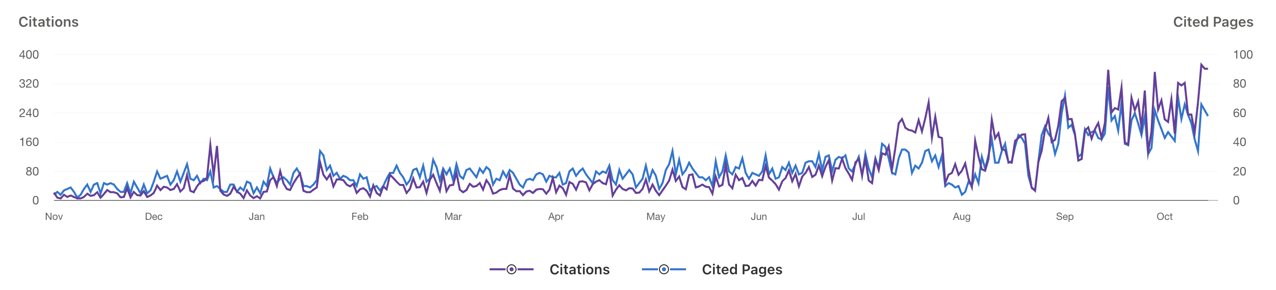
That said, I’d be cautious about the size of that effect. The base was small, and Bodnar is right that attribution here is correlative. But the direction matched what HubSpot saw: AI-answer visitors converting at roughly three times the rate of traditional search, because the buyer has already had the conversation.
The practical implication for anyone running SEO is a show’s transcripts are a content source your competitors cannot copy, and the guest appearances are citations you don’t have to pitch for. Yet most companies with podcasts are sitting on both and using neither.
Where Podcasts Fail
The wins above come with a long tail of shows that didn’t make it. Three failures account for most of them.
Starting At The Trust Stage
The show launches before anyone has borrowed an audience or booked the host on other shows. Twelve episodes, then silence. This is the majority of B2B podcast failures.
Treating Downloads As The Scoreboard
Downloads are the podcast equivalent of the sessions Bodnar says HubSpot watched for 15 years. They are inflated by bots and repeat fetches, and they say nothing about who listened.
Instead, the numbers that matter are which companies are listening, which guests became opportunities, and whether prospects mention the show when they inquire. If your hosting can’t tell you the first of those, you are flying blind.
Nobody Owning What Happens After The Recording
The interview ends, the episode publishes, and then the guest never hears from the company again. The 20% conversion rate above came from a workflow, not a microphone.
What This Means If You Run Growth
Greg Jarboe ended his write-up of the interview by arguing that the goal has changed. Inbound marketing was about showing up when a buyer searched. Now the buyer asks an AI first, and your company has to be the one they pick afterward. I agree, and I’d add that search alone can’t solve that problem.
Buyers choose companies they have noticed, heard, trusted, and seen named. The places those four things happen are feeds, shows, and AI answers, not result pages.
A podcast is the one channel that can do all four at once. It borrows an audience through guesting, earns listening time no outbound sequence can, builds relationships with the buyers you interview, and produces the specific, first-party content AI engines cite. However, it is also slow, operationally demanding, and easy to do badly, which is why most of them stop at episode 12.
HubSpot built these channels with a large marketing team and a head start of several years. Most B2B companies have neither. That is an argument for starting now, not for not starting.
So before you count downloads, count buyers. How many of the people you want to sell to have been on your show, or listened to it?
More Resources:
- Wikipedia, Podcasts & Reddit Now Drive AI Citations, Ask Your PR Team How They Did It
- B2B Buyers Choose A Vendor Before They Reach Out – 3 Ways To Be Visible When It Counts
- The Founder-Led Growth Loop: How To Amplify And Measure Executive Voice For Real ROI
Featured Image: beast01/Shutterstock