
While it still remains unclear how many major search engines we will end up with, it is still wise to track and compare your (and your competitors’) progress in all of the existing ones.
By comparing different SEs results you will:
- get deeper understanding of how search engines work;
- learn more about your competitors’ SEO techniques;
- tell which search engine is better (and necessary) to optimize for;
- define what works better for each SE.
1. Prase - a handy simple tool that shows you the results for 3 SEs (Google, Yahoo and MSN) on one page. It also allows you to exclude any of search engines and sort results by Google Page Rank.
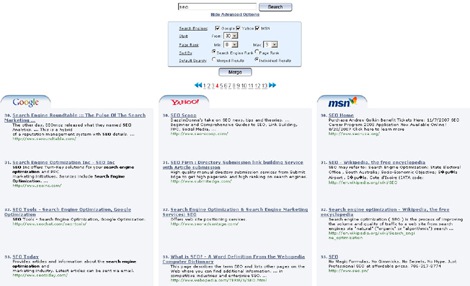
2. Yahoo vs. Google tool - offers a visual representation of the difference between the 2 SEs (Google and Yahoo):
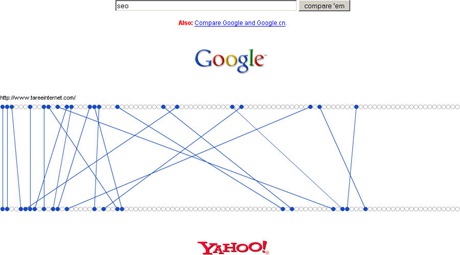
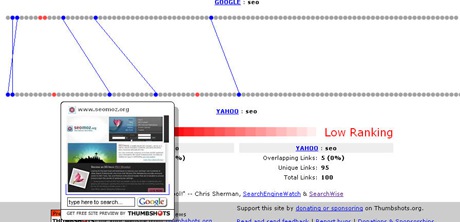
3. Thumbshots Ranking - similar to the above one but it also highlights the domain name you are most interested in:
![]()
4. Fuzz Find - is a pretty new one but offers plenty of options to play with and gives you the idea how the future of search engines and social media might look like. It merges data from 3 SE (Google, Yahoo and MSN) and from Del.icio.us. You have much freedom to sort the results based on any of the sources. It also includes related searches to give you more ideas to check:

| Features/Tools | Prase | Thumbshots | Fuzz Find |
| # of SEs | 3 | 2 | 3 (+Del.icio.us) |
| Additional Features | Sort by Google PR; start from any result; set the min. PR to filter low-PR sites |
Highlight the site you want to track | Sort the results based on any SE or Del.icio.us |
Two Bonus Tools:
- Yoople! = Yahoo! + Google + People - the tool that claims to combine G and Y! data and to let you change the site rankings by dragging any site to your preferred position; besides the tool saves each site position history for you to see most stable (hence best) results.
- Google Maps vs Yahoo Maps - side by side local search comparison tool.


Comments
20 responses so far ↓
Lynette on Mar 18, 2008 at 1:09 pm
Interesting, esp the graphical comparison.
I am writing you to ask for support or to hear if others have run into issues with Google’s Organic Search and Google’s AdWords. The company I work for, Laserfiche (www.laserfiche.com), spends more than $500,000.00 annually on AdWords. I’ve been having ongoing problems with sites that rank above us in the organic site of Google. I have done further research on these sites and have seen these sites use paid linking, paid directories, and forum pulling to gain higher page count for their sites. Google states that paid linking is against their policies and will sandbox sites that use just practices. We have reported these facts over and over to Google AdWords Account Reps and they have told us there is nothing they can do for us in regards to the sites in question. But they would help us with other marketing means to help our AdWords. We have asked for contact information to the Google Search Team and we still get nowhere with Google.
Has anyone else had issues like this with Google?
Please see our letter to Dr. Schmidt, CEO of Google.
http://www.laserfiche.com/newsroom/pressrelease/2008/031408_google.html
Thank you!
Lynette Wilson
Lynette.wilson@laserfiche.com
rumblepup on Mar 18, 2008 at 3:02 pm
Great post Ann! I love comparing SERP’s across SE’s, and these tools make it a bit more enlightening. I’ve used Prase a couple of times, and I’m glad to see it getting a bit better on load times. But you’ve completely surprised me with Yoople and FuzzFind. Thanks!
@Lynette - I can understand your frustrations, but I think you should be reading more about SEO best practices, than ranting about Google’s apparent unfairness. Having an Adwords account doesn’t get you top rankings. One look at your site and your rankings and even I could tell why you don’t have top SERP’s.
Ann Smarty on Mar 18, 2008 at 3:14 pm
@rumbalepup - thanks for the comment! Yeah, Prase is getting better… Yoople and FuzzFind are better to play with than actually analyzing (to me at least) but it’s definitely worth it!
@Lynette - try to outdo them rather than kill them ;)
Dan on Mar 18, 2008 at 4:25 pm
Paid Search and Natural Search should never have anything to do with the other. Why would a site that spends money rank higher in the natural results than those that do not. It is all about relevance…
Try doing some basic SEO….
LondonHotelsDealGuy on Mar 19, 2008 at 1:00 am
Ann, Interesting list of resources. Thanks for this! I’d suggest another good one for the list:
http://www.googlerankings.com/ - which searches Google, Yahoo, MSN and ASK at the same time. The plus here is - it can give the rank of your site for any keyword - very useful!
@Lynette - oh dear! You should work more on the organic SEO for your site. Shouldn’t blame the competitors and Google like this. It’ll get you bad vibes from them.
Pratheep on Mar 19, 2008 at 1:39 am
Ann Smarty,
Thank you very much for the list of websites. It helps!
Pratheep
Jansie Blom on Mar 19, 2008 at 2:12 am
Thanks for this Smarty! gonna give all these sites a looksee. hope you’re not sending an invoice ;)
Ann Smarty on Mar 19, 2008 at 2:43 am
@Jansie - not this time ;)
Chris Blackwell on Mar 19, 2008 at 5:28 am
I wish that Prase made a FireFox search extension, that would be really useful.
KenJones on Mar 19, 2008 at 5:36 am
Really like to tips Ann, great reminder that oranges (i.e. Google) are not the only fruit. Prase seems great in theory, but searches on there seem to have a habit of saying “Sorry. No results found.” for at least one out of the three engines. I even tried replicating the search in your example picture and go a big zero in the Google results. Maybe once they can sort out these issues it’ll become a really useful tool for comparing engines, but it seems a bit too sketchy to rely on at the moment.
Ann Smarty on Mar 19, 2008 at 5:40 am
@KenJones - true (unfortunately) but like I said, it’s getting better day by day…
@Chris - agreed! Would really great!
Doug Heil on Mar 19, 2008 at 7:14 am
These tools are nice and all, but I would recommend a website owner to look at his/her own website and try to make it better. If he/she isn’t getting referrals on certain phrases on the se’s, then he/she knows they have more work to do. You can find out if you are getting referrals from the se’s by reviewing your log files or by reviewing your stats program. It makes no difference if you are on page two or three or whatever if you are not getting referrals. A tool does not help you with your own website. Besides, are these tools abiding by the se’s TOS in regards to scouring their servers? I would recommend doing it a new way…… manually do a search on each engine yourself. A new concept, huh? :-) That’s if you really need to know where you rank. I’m not sure why people are obsessed with a rank when it only means something if you are getting targeted visitors. You can find out that info by looking at your stats program, as well as find out much more by looking at your stats. But yes; using the tools above will show you your pagerank, and we all know how useful that is. :-) Oh, not to mention the different results you get depending on what datacenter is displaying those results.
Can someone tell me the benefits of checking your rank? I’m not thinking of any right off hand.
Javaun Moradi on Mar 19, 2008 at 10:54 am
Interesting post. I agree it’s always interesting to see new tools and echo Doug’s concern about whether they violate the engine’s TOS. Ultimately though, the information you glean — whether from a tool or a manual query — is only as good as the action you plan to take based on the data.
Google in particular (with its Universal Search) is turning SERP results on its head. Like me, you may have multiple browsers (i.e. Firefox and MSIE) and may use one for most of your surfing. I encourage everyone to experiment by making queries in your normal browser. Then, in your secondary browser, clear all cookies,history, etc. and try the same query. You will see very different results, especially if you were logged in to your Google account on the first browser. Google will tailor the SERPs results to your particular habits and tastes, give you results that are personally relevant. Expect that to only continue in the future.
@Lynette. I understand your ranking frustration, but there are some very basic flaws in your site that are causing you to not rank well. Your page titles are somewhat duplicative and may be perceived to be stuffing keywords. At the very least, they aren’t human friendly, so even if you ranked well, you might not get clicks. You also have a canonical URL problem. I didn’t even look any further to see if there were other problems such as banned practices or site obstacles. I’d start with a fundamental site review of all the basics. Good luck!
Doug Heil on Mar 19, 2008 at 4:01 pm
Good stuff Javaun!
You pointed out a few probs with Lynette’s site that is one of my points I was trying to make. So many out there are constantly looking for ways to do things…. like “tools”, but fail to see what they actually control….. their own sites. Instead of chasing some silly tool out there, they should be learning how to do well with their own site, and simply learn the very basics of how to build a site for visitors and for engines. Too many sites don’t know the very basics, and I feel one group at fault is the SEO industry in general. It’s more profitable to peddle the latest “tool” than it is to actually help an individual site and all it’s problems. One size does Not fit all. It never has and it never will. No tool will help that site do well. Looking at some competitor site will not help that site do well either.
BTW; I see your team… Michigan, lost Pryor to those damn Ohio State Buckeyes. LOL Well, I’m an Ohio boy and totally love it. :-)
Rocky on Mar 19, 2008 at 11:01 pm
Thanks, Ann. Interesting and useful resources.
searchboth.com is a tool i used before.
Ann Smarty on Mar 20, 2008 at 2:37 am
@Javaun Moradi: very good points as for trying queries in different browsers.
Doug Heil: these tools are not about pagerank, they are about comparing different search engines. And I do not suggest blindly using the tools without any further analysis. To me a tool is just another way to look at things from a different angle (alongside with manual work, checking different browsers and IPs, learning theory, etc)… Tools are great to play with because they allow you to see something you wouldn’t have managed to see without them. In the end I still usually end up doing all the work manually.
As for the TOS, let Google and other SEs handle this :)
Doug Heil on Mar 20, 2008 at 7:23 am
Yes; the SEO industry seems to say all the time to let Google handle things they do not like. The hell with taking responsibility ourselves.
Good luck with your tools. :-)
Ann Smarty on Mar 20, 2008 at 8:19 am
@Doug - no, they are not mine and I am in no way affiliated with the tools. The day I will be promoting my own tool I’ll be glad to take the responsibility ;)
Mathews Rosario on Mar 21, 2008 at 8:49 am
Thanks For The Wonderful Insight into SE Tools, I haven’t known, that the webbies can find so good Comparision Tools.
Website Competitive Intelligence on Mar 26, 2008 at 12:04 pm
Interesting thread. I feel that SERP can best be viewed as one metric for tracking how well a site owner is doing over time in refining many of the good points made above about site architecture, and content, etc. Site owners can also improve their search engine performance by better understanding some of the related factors that also influence their SERP, such as the number and quality of inbound/outbound links, meta tag usage, alt tag usage, etc., etc., and there are many useful articles to be found on the web on these aspects as well. Another good way to compete with/improve your site’s ranking vs competitors is to pay attention to what is helping them achieve better rankings for relevant search terms. Doing an inbound link analysis on high-ranking competitive sites can be an interesting exercise in uncovering potential high-quality linking opportunities for your own site. Naturally, the more quality inbound links (hopefully anchored with your preferred keywords), the better your Google PageRank and overall SERP will be in all the search engines — not to mention the fact that high-quality inbound links also produce additional high-quality traffic in general. Content is king, but careful web marketing strategy and tactics also don’t hurt!
My company, Attaain Inc., has included many of these kinds of web-marketing tools as a component of our overall Competitive Intelligence and Market Intelligence software/service, AttaainCI. These tools include the ability to quickly compare your own web tactics versus competitors in areas such as multi-search-engine SERP and weighted exposure by keywords, web site meta tag usage, inbound/outbound link analysis, website collateral, website traffic trends/page rankings, keyword trends and others metrics. Our clients find that careful ongoing analysis of these competitive site metrics, and continued refinement of their own web marketing tactics can produce significant improvements over time in their web site performance. Useful tools like those mentioned in this post also exist separately in various places as well, and each can provide insight into specific aspects of improving website performance when thoughtfully applied. There is no “silver bullet” to skyrocket search engine performance, but there certainly are a number of influencing factors that can be analyzed and acted on to continuously improve website effectiveness. Thanks again for the interesting post!
Daryl Scott, Attaain, Inc.
AttaainCI - Active Intelligence for Strategic Advantage
www.attaain.com
Leave a Comment