H1 - H6 elements “briefly describe the topic of the section they introduce“. They form a page HTML semantic structure that can “be used by user agents, for example, to construct a table of contents for a document automatically“.
Heading tags will not dramatically effect the page rankings, of course, but the correct usage of the elements will “reinforce” other on-page factors and structure the contents of a document. Being one of the methods to give your keywords prominence, the heading elements clarify the page main topics (both to users and bots).
A page semantic structure analysis is an important part of site SEO diagnostics that can help to:
- identify on-page issues;
- analyze your (competitors’) main keywords;
- improve your keyword prominence;
- understand if you are outlining your content correctly.
Here are two tools to help you analyze any page semantic structure:
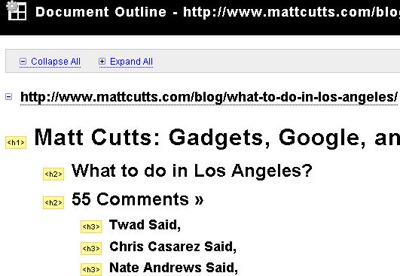
- Web Developer FireFox extension gives any page semantic outline (located under “Information” => “View Document Outline“):
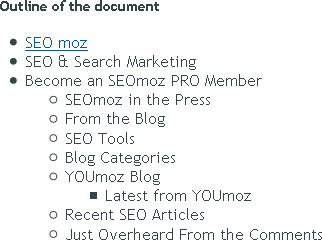
- w3 Semantic data extractor structures a document based on H tags usage:


Comments
13 responses so far ↓
Jaan Kanellis on Aug 19, 2008 at 6:53 pm
So is it the end of the world if I have H3 on my page and no H1 or H2?
Matt on Aug 19, 2008 at 10:47 pm
Good stuff!
Mercy on Aug 20, 2008 at 12:03 am
@Jann - Its not the end of world, but H1 always do better with SE Bots compared with h3 or h4.
Chaitanya Patel on Aug 20, 2008 at 12:50 am
I thought a lot of time, is there still importance of H Tags, as i have been seen many sites without H tags rankings on top of SERP’s, but thanks for this post for giving detailed information on how H tags relates with keyword prominence.
Thanks, Smarty.
Web Agency Chieti on Aug 20, 2008 at 1:41 am
@Jann
did you never see a book starting from the section, instead of a title. Starting your page with the h3 tag ( that it’s not absolutely forbidden) let think to the spider that you don’t have the title of your book, just sections.
g1smd on Aug 20, 2008 at 4:35 am
The numbers show relative importance, and say nothing as to how those should be visually rendered.
However, you should generally start at H1 for the most important, and work down for the rest.
CSS takes care of what they look like on screen. :-)
Jaan Kanellis on Aug 20, 2008 at 6:47 am
I understand the analogies and the reasoning, but did anyone test this in a thread to know if it makes even the slightest bit of difference at all?
Web Agency Chieti on Aug 20, 2008 at 7:36 am
@Jaan
Unfortunately I actually deleted my test pages, but I can assure u, as probably most of us that a document with an H1 is heavy than one with H3.
A starting doc.
You can do a stupid test if u want. Create two new pages, same content, same title. One with h1, and one with h3. Link both of them to an index of a dir that is new.
In yout content or title write an absurd word that u and only u know (ex. thsstestforhtmlhedtag) and submit to google. wait some days and then try to look for that occurence and see the serp order.
That’s all.
WebSite Design Orange County on Aug 20, 2008 at 10:11 am
“U” is NOT a word!
It takes .0005 seconds to actually type the word “You”, it’s not that hard. Let’s not let intelligence and grammar fall into the abyss of laziness.
Web Agency Chieti on Aug 20, 2008 at 10:21 am
@WebSite Design Orange County
What’s the matter? Did you get something wrong today, or simply slept without sheets into the blowing wind? :)
Michael Martinez on Aug 20, 2008 at 10:56 am
Semantic structure refers to the arrangement of words, not to how they are marked up in HTML. Search engines are still using primitive semantic algorithms that are not likely to be influenced by whether you break your copy up with section headers.
In semantic analysis you look for relationships between words and groups of words. If you can identify patterns you’ll be able to notice triggers that allow acceptable substitutions.
We’ve already begun to see these kinds of substitutions in suggested alternative searches and in the variant copy expressions that appear in relevant search results (as opposed to irrelevant copy expressions that have always appeared in poorly organized queries).
We’re not yet to the point where a query like “canine trainer” produces results similar to the “dog trainer” query, but when we get there it won’t be because of HTML markup.
Web Agency Chieti on Aug 20, 2008 at 11:04 am
@Micheal
To be more precise, doing semantic HTML mean use markup correctly, and it’s not dependend by the word arrangement at all.
If you have a heading use the heading element, beginning with the H1 element. If you have a paragraph, use a paragraph element. If you have a list, use a list item element. yadda yadda yadda
Ann Smarty on Aug 20, 2008 at 12:40 pm
@Michael : I guess we are talking about two different things… I was referring to HTML semantic structure, not semantic structure in its broad meaning…
Leave a Comment