
What is a keyword modifier?
A modifier is a word that in combination with your core keyword creates your long tail strategy (definition by Dan Thies). Most often a thematic modifier can be:
- a word of a general meaning (e.g. “guide”, “best”, etc);
- a word related to your niche (e.g. “quote” for the finance niche or a related brand);
- a geo-specific word (e.g. “Las Vegas”, “Nevada”, etc).
Why is it so important to somehow organize your keyword modifiers?
More often than not modifiers are discovered by chance (or naturally) – you publish an article for your core term and then discover that that was not the keyword itself that generated SE traffic for the page but this keyword in combination with some other word that naturally appeared within your content. Now imagine how much more traffic you could attract if this little word was used deliberately and if you actually expected this to happen. By organizing your long tail list you will:
- learn how to use your keywords more effectively;
- optimize your internal website structure and internal anchor text;
- get new ideas what to write about.
Why is it hard to organize your keyword modifiers?
Modifiers are hard to spot because they usually pop up unexpectedly and get lost within ‘more important’ keywords that generate higher volumes of traffic.
So, how do you organize your keyword lists to get full control of your thematic search modifiers?
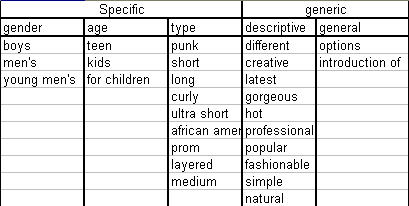
1) Word-per-category structure: organizing modifiers based on their semantic meaning in two large categories (general and niche specific) and multiple subcategories. With words of generic meaning you have more freedom: you may use them anywhere throughout your content. For niche specific words the best way is to create a page for each of them. For ‘hair styles‘ term for example niche specific subcategories may include: age, type, and gender:
2) Tree-like table where ‘tree body’ is your core term and ‘tree branches’ are your thematic modifiers (I’ve described this method in my Youmoz post in more detail). This approach is most effective for organizing generic modifiers that can be used anywhere independent of the article main topic. The idea is as follows: you highlight the precedent and antecedent modifiers in different colors to quickly find one when creating new content.
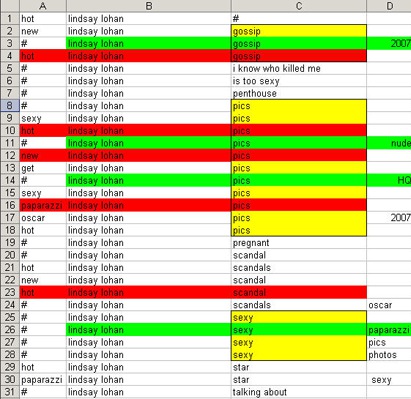
The beauty of this approach is that you can always merge any of these lines to get 5-, 6-, etc word combinations.
You can also throw this data through a pivot table to see how often each word was used (hat tip to fellow Mozzer Vinny).
3) Hierarchic table: from two- to three-, four-, etc word combinations:

This approach can be most effectively used for optimizing website internal architecture.
More reading on thematic keyword modifiers:
- Grow an Organic Search Ranking Using Thematic Search Modifiers
- Aaron Wall’s spreadsheet of Most Frequent Keyword Modifiers (xls)
