

It seems that Demand Media and its recently filed IPO has re-ignited a lot of the discussion that was first set in motion after Wired’s Daniel Roth wrote a feature article titled “The Answer Factory: Demand Media and the Fast, Disposable, and Profitable as H**l Media Model” back in October 2009.
Much said about the quality (or lack thereof) of the content (on the order of thousands of new videos and articles every day) that Demand Media churns out – some labeling it a “content mill” that is polluting the Internet with low-quality information. But one thing is certainly true: Demand Media has turned the process of web publishing into a science.
My goal in building any web property is to concentrate on creating the absolute best website in that particular market. If I can’t honestly say that a website of mine deserves to rank #1 for a given keyword phrase because it offers the best information, best user experience, etc., then it’s time to go back to the drawing board and work even harder! That being said, we can probably all stand to learn some things from Demand Media’s system of publishing content, right?
While I would hope that some of the high-quality pieces that I have published on some of my websites, like our credit card concierge experiment or our car insurance guide piece, would be considered to be of slightly higher quality then the infamous “Homemade Donut Recipes” video, it’s important to remember that in order to have long-term, sustainable success online (especially as a niche website), the focus must be on quality.
Using elements of Demand Media’s publishing system to be more efficient is smart. Mimicking Demand Media’s approach to less than great content … not so smart. With that out of the way, here is how I use WordStream to build my own “Mini Demand Media” system to be more efficient when publishing high-quality content.
Step #1: Automate the Process of Grabbing Large Buckets of Potential Keywords to Target
Demand Media has an edge on the average webmaster, as they are able to get access to very large keyword data sets direct from various ISP’s. But if you sign up for access to the WordStream API and then use the Sample PHP code for interfacing with WordStream’s API Server that my business partner/programming ninja John Gadbois coded up, then you will have a very large group of keywords to use that rival what Demand Media has access to.
Since the goal here is automation, and I am already a huge WordPress fan, I use a custom WordStream WordPress plugin courtesy of Ninja John that lets me enter in a seed keyword. Then the plugin returns a listing of all of the related keywords direct from WordStream (in some niches right around 50,000 keywords in total).
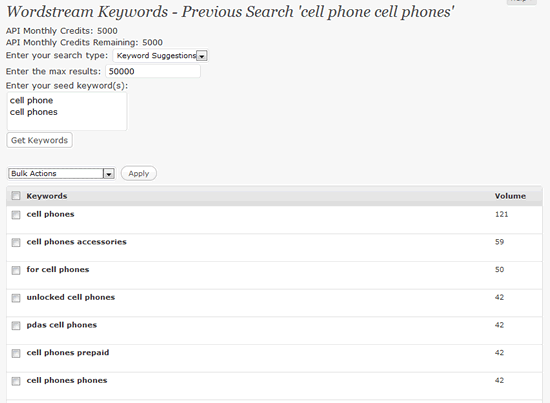

Now that I have about 50,000 related keywords sitting in my WordPress admin screen for my given website niche, I need to move on to the next step of deciding which keywords I should use for creating new content on the site.
Step #2: Filter Out the Unprofitable Keywords and Keep the Profitable Keywords
Culling down a list of 50,000 keywords (many of which sound very similar) can be a chore. Demand Media uses a clever algorithm to predict which keywords will be the most valuable to them if turned into articles or videos on their websites. It certainly wouldn’t be rocket science to take the time to code an algorithm that takes into account CPC information from the Google AdWords API, data from your site’s analytics program (like maybe the awesome Clicky API), etc. so that you essentially re-create the usefulness of the Demand Media algorithm. But for some things (and this step may be one of those things) there is no substitute for human attention.
Getting back to my earlier point about having the goal of actually building the best website in a given market, there are some things that a machine just simply cannot do as well as a human. If you truly understand your market, then it would be very, very difficult, if not impossible, to algorithmically make decisions in choosing the best keywords to pursue just as well as you could in going through the keywords by hand.
Certainly some CPC information or some other basic starting info might be helpful to pre-select certain keywords for you to consider, but ultimately if you want your site to be the best source of information in a given market then you had better have expert-level knowledge of that niche or hire someone who does. Spend some time personally choosing keywords on this step before rushing on to the next step.
Step #3: Turn Those Profitable Keywords into High-Quality Content
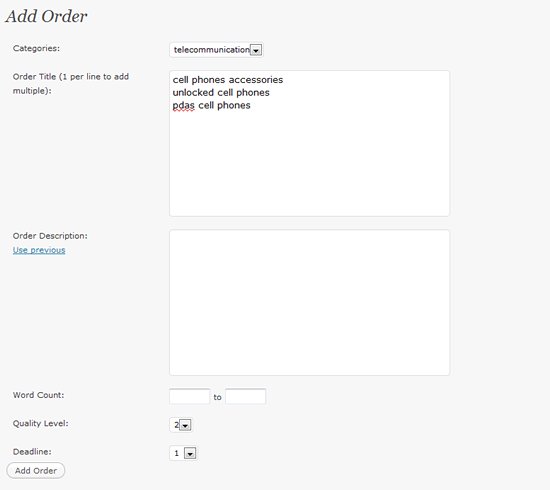
The last and final step is to turn those hand-selected baskets of keywords that you have predicted will be profitable into pieces of content. The WordStream Plugin that I mentioned earlier also has a companion TextBroker Plugin (again courtesy of Ninja John) that allows me to bulk select keywords from my profitable keyword list and either bulk create new posts/pages in draft status for my team of professional writers and editors to begin working on in WordPress or send them to TextBroker via the TextBroker API.
The goal in this step is of course to automate the Demand Media system of creating content – so that you have an efficient and scalable way to publish content – without sacrificing quality. Sure, you can pay your writers very cheap and get a load of cheap content, and in some markets that may actually be all that you need. But what happens when someone comes along with all of the same efficiencies as you thanks to this “Mini Demand Media” model, but they only publish ultra-high-quality content based on those keywords?
May the best website (content) win!
What do YOU think?
What do you think of the Demand Media publishing model? What characteristics of Demand Media’s business model should be mimicked and which things should not? How would you improve on the “Mini Demand Media” system for efficiently publishing content?