
Julie Kent

ISP Injecting Yahoo Logo & Own Ads on Google Homepage, Google is Not Happy

December 13th, 2007 by Julie Kent | 6 Comments

Canadian cable and telecom giant Rogers Communications has begun testing new technology on its high-speed internet service that inserts Rogers-centric messages and advertisements on third-party websites. While that in itself is enough to piss off the likes of Google, who pride themselves on a clutter-free homepage, the fact that the messages carry the name of Rogers’ co-branded high-speed internet service with Yahoo, is even more upsetting to the search giant.

The People For Internet Responsibility (PFIR) first unveiled the testing of the new technology, and on their blog PFIR posted a screenshot depicting the degradation of the Google homepage with a Yahoo-lovin’ message notifying a user that he was approaching his monthly data limit. The name of Google’s archenemy, Yahoo, shows up twice on the page.
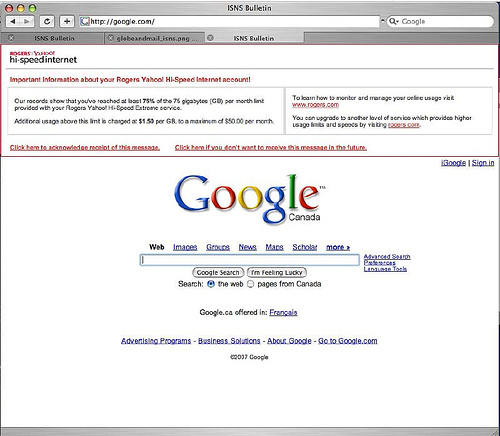
Rogers’ recently confirmed their underhanded move to The Toronto Star, but defended the practice. Rogers argues that it’s a lot like a wireless provider sending messages to a customer’s cell phone. Although I would argue that it is not quite the same thing, as a message to one’s phone would go into a text message inbox, and not take away from the viewing area on your phone’s screen.

Google, in the meantime, is hopping mad over the revelations, and argue that Rogers has violated the concept of net neutrality. A spokesman for Google said:

“We are concerned about these reports. As a general principle, we believe that maintaining the Internet as a neutral platform means that carriers shouldn’t be able to interfere with web content without users’ permission. We are in the process of contacting the relevant parties to bring this to a quick resolution.”

Rogers is not only defacing Google.com, but any other website a user may visit, vandalizing the painstakingly thought out and planned website designs with obtrusive messages that could be better handed out through a simple e-mail alert. As a website owner myself, I would be peeved to know that a company I have nothing to do with could alter visitors’ experiences at my site.




Comments

6 responses so far ↓

  • Chris Olstrom on Dec 13, 2007 at 3:25 pm

    If this sort of capability is allowed to go unchecked, how long before they abuse it for commercial gain? I explored this the other day, along with other potential impacts to user security and the integrity of the web at large. The post is served with a side of SSL, to prevent it from being modified on the wire by unscrupulous ISPs.


    https://chris.olstrom.com/blog/2007/12/11/rogers-modifies-web-pages-violates-consumer-trust/

  • Loren Baker, Editor on Dec 13, 2007 at 4:15 pm

    I’ve seen multiple Internet cafes and free Wifi services around the globe use a similar technique to serve ads over any site, and not just the Google homepage.

    Propeller and About.com also link out serving target pages within a framed page, which sometimes has ads.

    Sure, its not the same in the About.com example, but similar.

    At least they are not replacing the Google results with PPC ads like a great deal of the cafe’s I’ve used, especially in tourist towns.

  • Mike D on Dec 13, 2007 at 5:05 pm

    Ok ..is not some free internet Cafe, this is a home or business connection.

    As an ISP we would never think of pushing content on to our customers. If nothing more it is stealing bandwidth from the customer. Charge the customer to have banners splashed across the browser.

    I have a feeling that they will remove the banner or Google will buy them out and have it removed.

  • DeepFreeze on Dec 14, 2007 at 7:46 am

    This is way too much of a Crazy move by an ISP. People must be going nuts just thinking about it.

  • Shawn on Dec 14, 2007 at 2:50 pm

    Weird. I use Rogers at my house and I haven’t seen anything like this pop up at all. I understand they’re still testing it, but I’ll keep my eyes open for it. I hope they use it sparingly.

  • Chris Olstrom on Dec 14, 2007 at 3:39 pm

    Used sparingly or not, this capability (combined with the fact that they have used it) damages the integrity of your internet use.

    How can you trust that the content you receive is actually the content sent to you if it is reasonable to believe that somewhere in between, it may have been modified.

    SSL/TLS offers a remedy for this, and does ensure the integrity of your sessions… if only it were more widespread. Self-Signed Certificates are good enough for validating the contents sent to you, even though they don’t validate the identity of the sender. The problem there is that since the self-signed cerificate is not signed by a trusted authority… it throws up a lovely little security warning in most browsers, which isn’t always something you want.

Leave a Comment